



















From Generative AI to Agentic AI: The Next Evolution of Enterprise Automation
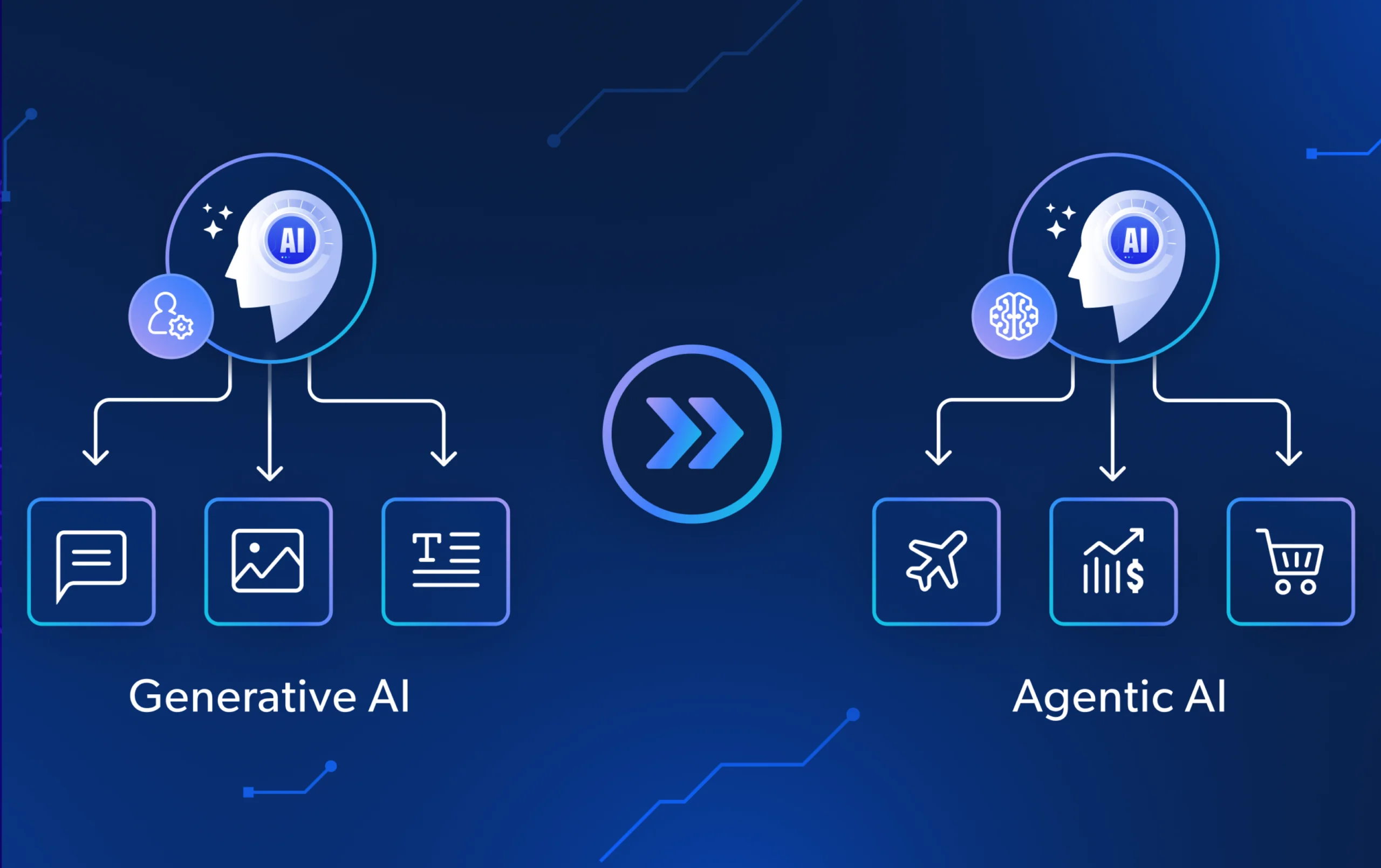
Generative AI has reshaped the business world in only a few years. From automated content creation to intelligent chatbots and document processing, enterprises finally began experiencing the real value of AI at scale.
But now, a new shift is happening. Agentic AI — the next evolution beyond Generative AI — is emerging as a transformative force that will redefine enterprise automation, decision-making, and digital operations.
Unlike traditional generative models that simply “respond,” Agentic AI systems can plan, reason, act, and iterate — much like a digital employee capable of completing multi-step tasks.
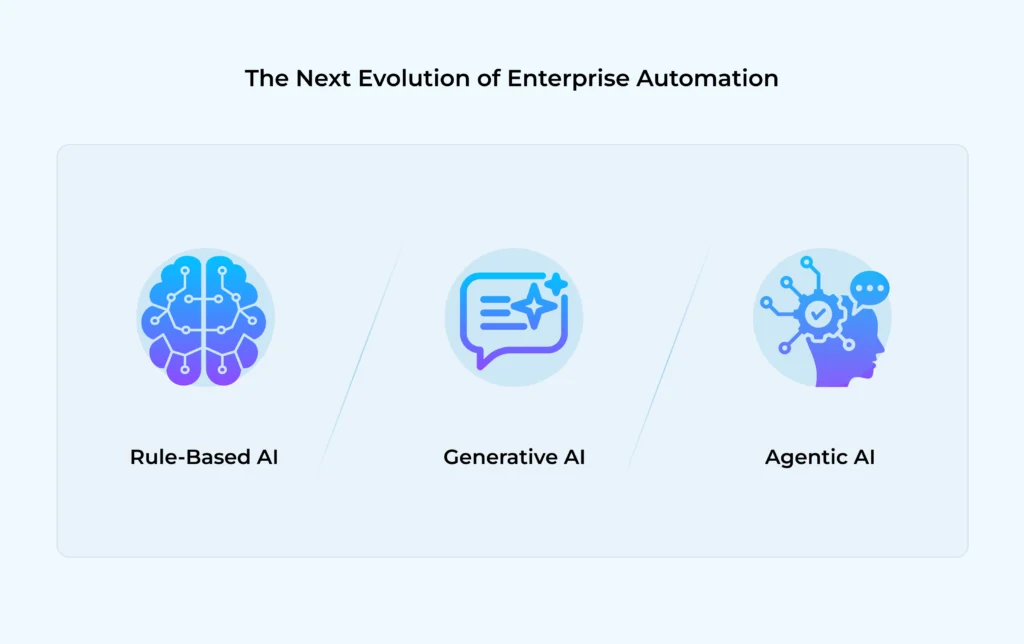
In this blog, we explore what Agentic AI is, how it differs from generative AI, and why organizations should prepare for this new frontier of intelligent automation.
What Is Agentic AI?
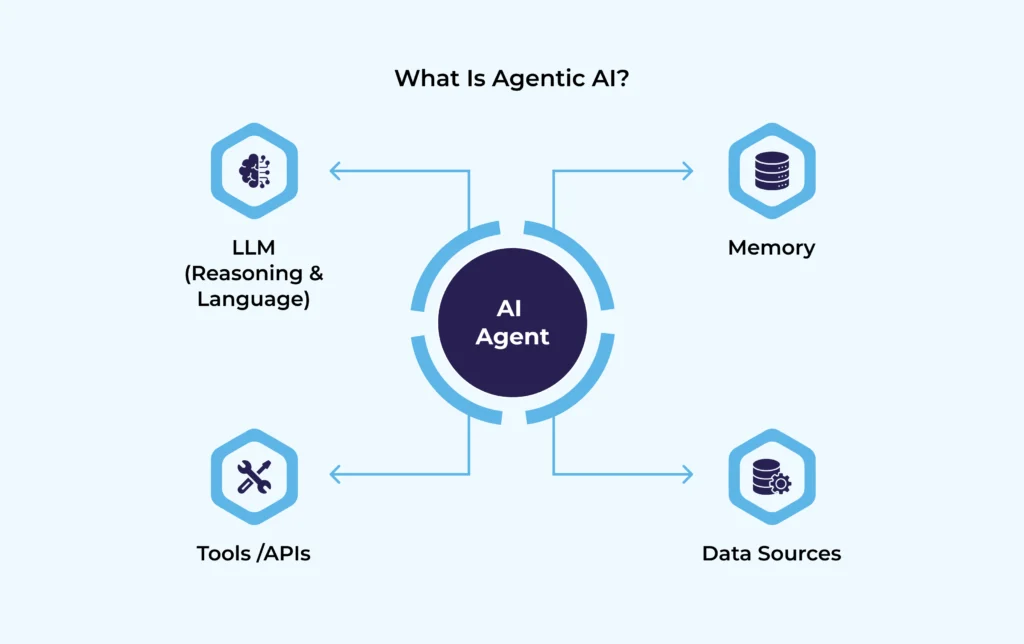
Agentic AI refers to AI systems that can autonomously perform tasks, make decisions, and execute multi-step workflows without constant human instructions.
These systems combine:
-
- Large Language Models (LLMs)
- Reasoning & planning algorithms
- Memory modules
- Tool usage capabilities
- Real-time feedback loops
- Autonomous decision-making
An AI agent doesn’t just generate text — it acts.
Example:
A generative AI chatbot can answer a question.
But an Agentic AI system can:
-
- Receive a business goal
- Break it into steps
- Access tools or APIs
- Execute workflows
- Validate results
- Report back with outcomes
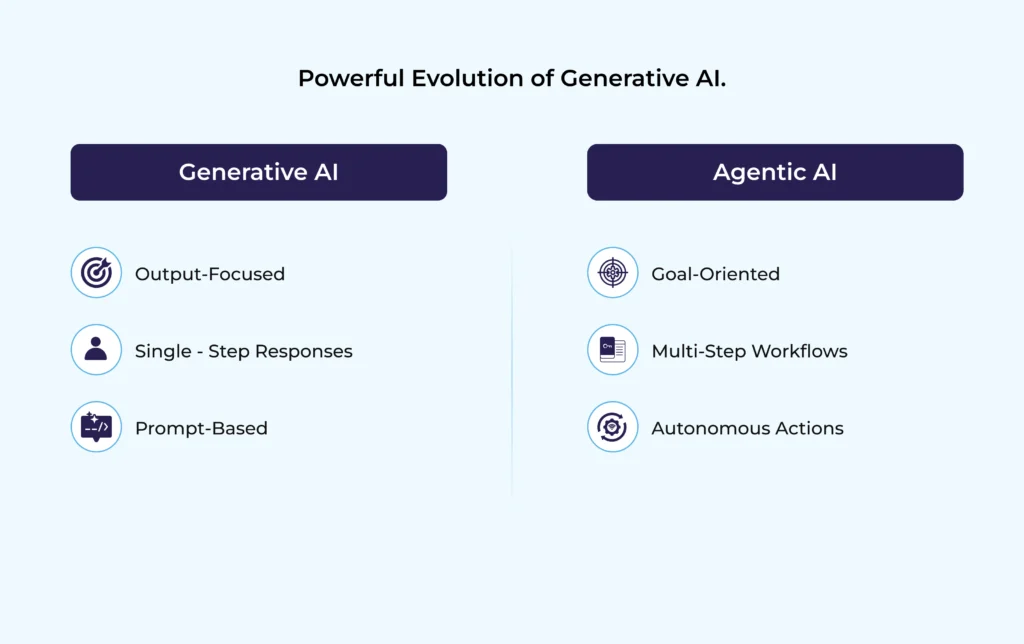
This makes Agentic AI a powerful evolution of generative AI.
| Feature | Generative AI | Agentic AI |
| Primary Role | Generate content | Perform actions & tasks |
| Capabilities | Text, image, code, content generation | Planning, reasoning, acting, tool use |
| Autonomy | Low | High |
| Memory | Session-based | Persistent, long-term |
| Workflow Execution | Single step | Multi-step, goal-driven |
| Examples | ChatGPT, Gemini, Claude | AI agents, autonomous copilots, multi-agent systems |
Why Agentic AI Matters for Enterprises
1. Automates Complex, Multi-Step Business Processes
Instead of automating simple tasks, agents can automate full workflows, such as:
-
- HR onboarding
- IT ticket resolution
- Financial report generation
- Data validation & processing
- CRM task handling
- Software code review + testing
This dramatically reduces repetitive manual work.
2. Enhances Decision-Making with Reasoning Capabilities
Unlike generative AI, which can hallucinate, Agentic AI uses data, context, and tools to make better decisions.
Example:
A supply chain agent can analyze inventory, predict shortages using ML, and automatically trigger purchase orders — without human involvement.
3. Improves Productivity Through Autonomous Execution
Enterprise efficiency increases when AI agents:
-
- Schedule workflows
- Interact with business applications
- Retrieve real-time data
- Execute tasks on behalf of employees
This creates “digital teammates” who support human workers 24/7.
4. Integrates Smoothly with Enterprise Systems
Agentic AI works with:
-
- ERP systems (SAP, Oracle)
- CRM platforms (Salesforce, HubSpot)
- HRMS tools
- BI dashboards
- Data lakes & warehouses
This allows end-to-end automation across business units.
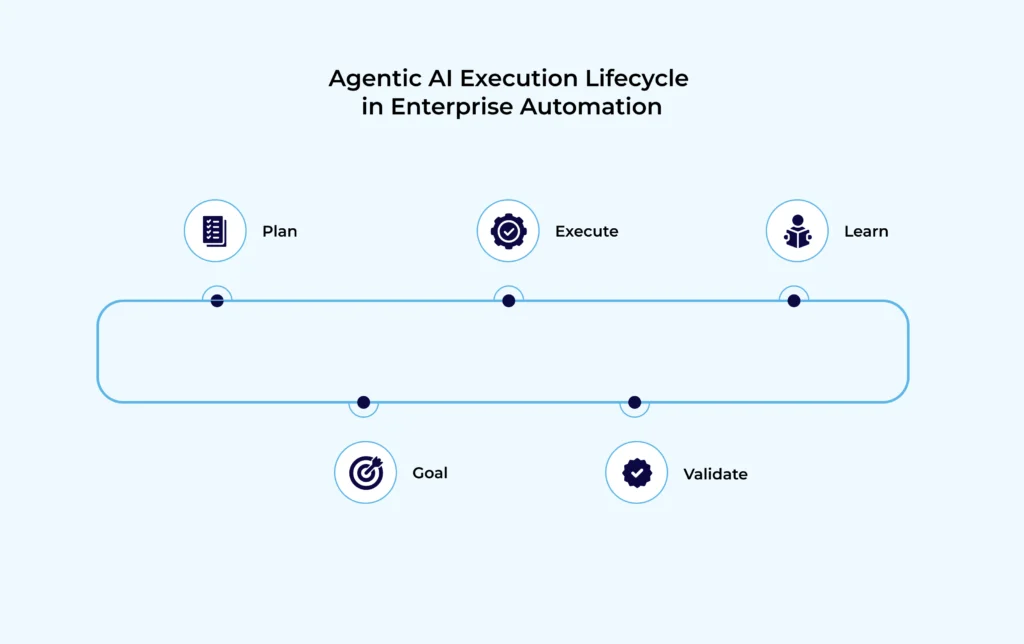
How Agentic AI Works: A Simplified Lifecycle
-
- User sets a goal
Example: “Create a sales performance report for Q4.” - Agent breaks goal into tasks
Fetch data → Clean data → Analyze → Generate insights → Format report. - Agent uses tools & APIs
BI tools → Databases → Excel → Dashboards. - Agent executes workflow autonomously
No human micromanagement required. - Agent validates results
It checks for errors, missing data, or inconsistencies. - Agent provides output
Clean, accurate, formatted report delivered to the user.
- User sets a goal
This “sense → think → act” loop is what differentiates Agentic AI from all previous AI waves.
Real-World Use Cases of Agentic AI in 2026
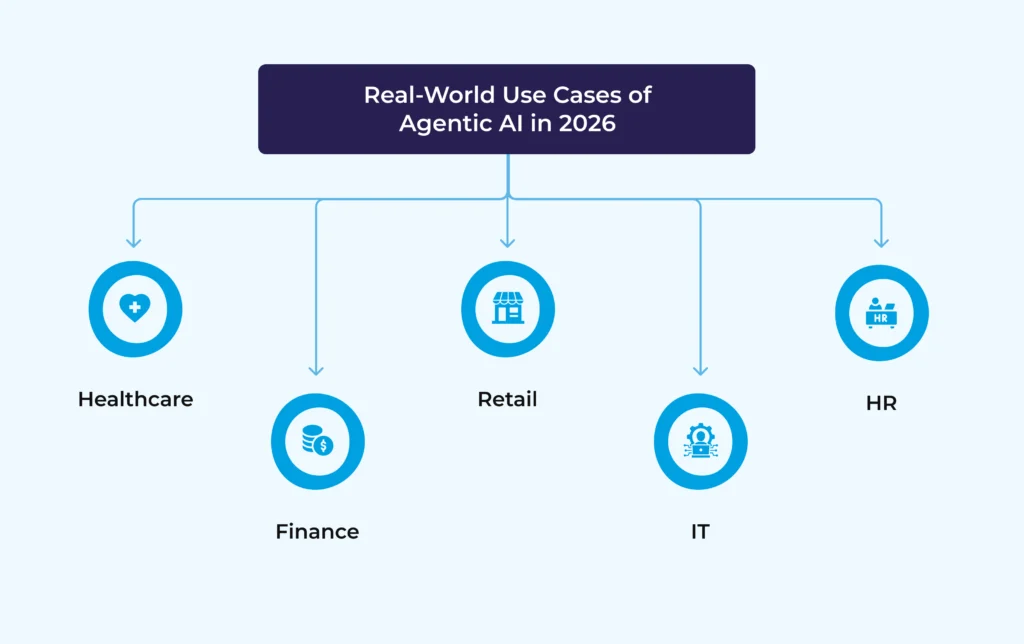
1. Finance & Accounting
| Automated financial reporting | Invoice processing & reconciliation |
| Audit preparation | |
2. Healthcare & Life Sciences
| Clinical trial automation | EHR data entry & summarization |
| Patient triage workflows | |
3. Retail & E-Commerce
| Automated product listing | Dynamic pricing |
| Supply chain optimization | |
4. IT & Software Development
| Code generation + debugging | Automated QA testing |
| Infrastructure monitoring | |
5. HR & Talent Management
| Role-based screening | Employee onboarding |
| Performance document generation | |
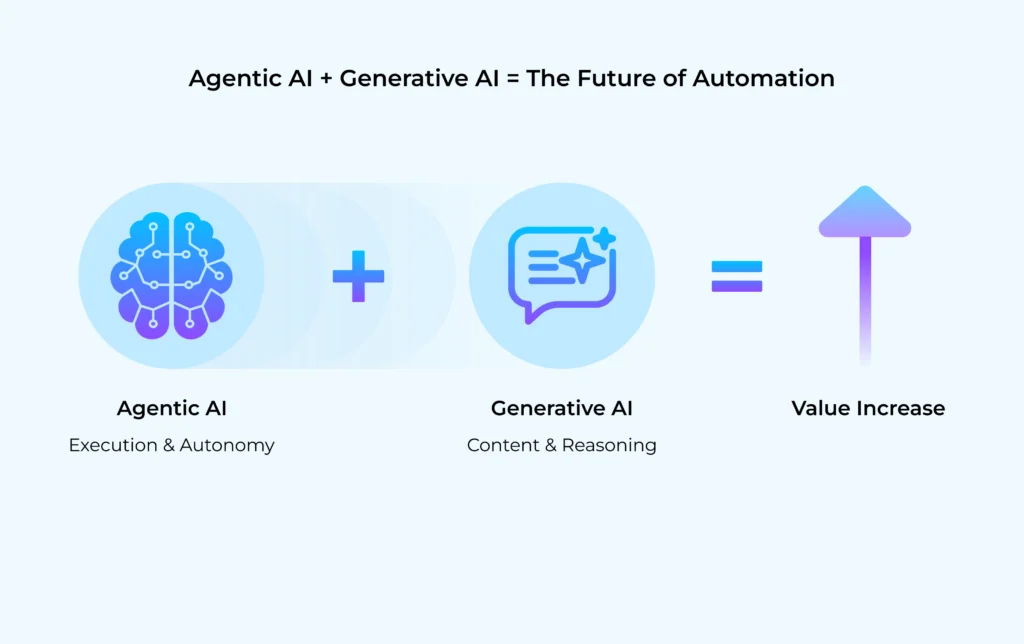
Agentic AI + Generative AI = The Future of Automation
Agentic AI does not replace Generative AI — it builds on top of it.
-
- Generative AI creates content, insights, instructions
- Agentic AI executes actions and finishes tasks
Together, they enable end-to-end enterprise automation.
This convergence will power smart enterprises where AI handles operations, and humans focus on innovation.
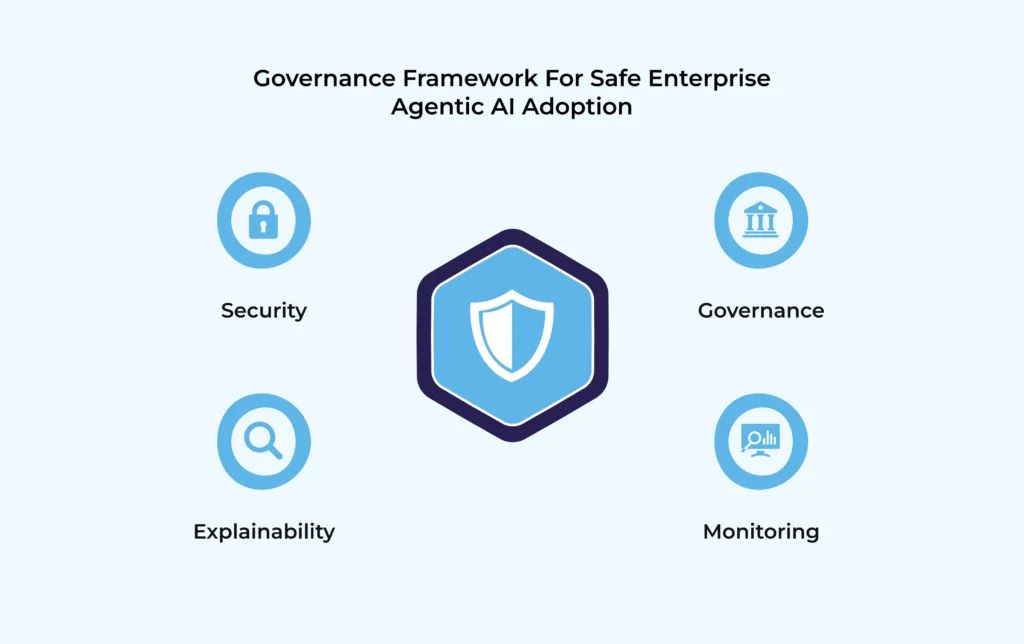
Challenges Enterprises Must Address Before Implementing Agentic AI
-
- Data Quality & Governance
Poor data = poor decisions
Strong governance = safe agent behavior - Security & Access Control
Agents must only access allowed tools and data. - Explainability & Transparency
Stakeholders must know how an AI agent reached a decision. - Long-Term Monitoring
Agents need supervision, evaluation, and continuous improvement.
- Data Quality & Governance
How Enterprises Can Prepare for Agentic AI
Here’s a clear roadmap:
-
- Strengthen your data foundation
Adopt clean, governed, structured data models. - Modernize AI & ML infrastructure
MLOps + scalable model deployment becomes essential. - Build modular workflows
Processes must be “AI-ready.” - Experiment with pilot AI agents
Start with low-risk, repetitive tasks. - Train teams for human-AI collaboration
Employees must understand how to work alongside AI agents.
- Strengthen your data foundation
Key Takeaway
Generative AI was only the beginning. Agentic AI is the next major shift that will reshape enterprises, accelerate automation, and unlock new levels of efficiency.
Organizations that adopt it early will gain a significant competitive advantage — with faster decision-making, smarter operations, and more empowered teams.
As the future evolves toward autonomous digital ecosystems, businesses must prepare to integrate AI agents as core components of their operating model.