



















How Enterprises Can Leverage AI for Growth in 2025 and Beyond

The enterprise landscape is undergoing a radical shift, powered by the relentless march of artificial intelligence (AI). Once a futuristic concept, AI has evolved into a strategic catalyst, driving innovation, agility, and operational transformation. As we head into 2025 and beyond, AI is no longer just a differentiator—it’s a necessity.
Enterprises that harness AI strategically are not just improving their processes—they’re reimagining business models, discovering untapped opportunities, and positioning themselves as leaders in the digital-first economy. This blog explores how businesses can leverage AI to achieve sustainable growth, remain resilient in uncertain times, and prepare for a future where adaptability is key.
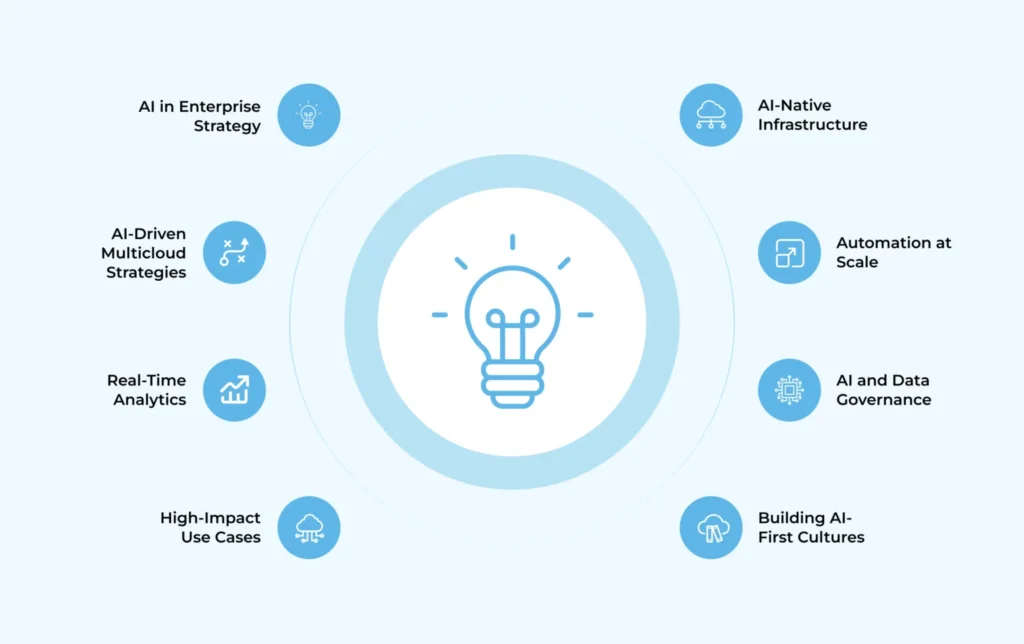
Strategic Pillars of AI Growth in 2025
1. AI Is Now Core to Enterprise Strategy
Over the past decade, enterprises adopted AI in pockets—fraud detection, chatbots, recommendation engines. In 2025, AI will become embedded at the heart of enterprise strategy. C-suite leaders are no longer asking “Should we adopt AI?” but rather “Where can AI have the most impact?”
From customer experience and IT operations to product development and marketing, AI is playing a foundational role in reshaping the modern enterprise. Strategic implementation of AI now influences:
-
- Faster, more accurate decision-making
- Real-time operational insights
- Enhanced employee productivity through intelligent automation
- Personalized customer interactions at scale
In this new era, AI isn’t just a tool—it’s a strategic partner that helps businesses evolve.
2. The Rise of AI-Native Infrastructure
AI is not just transforming software; it’s redefining infrastructure. Cloud platforms have evolved to support AI-driven workloads with purpose-built capabilities. Hyperscalers like AWS, Microsoft Azure, and Google Cloud now offer integrated AI tools, dedicated AI processors (like GPUs, TPUs), and managed services that abstract complexity.
Key trends in AI-native infrastructure include:
-
- Predictive Cloud Resource Management: With AI-driven auto-scaling and workload orchestration, enterprises are seeing dramatic improvements in efficiency and cost optimization. Systems can anticipate demand spikes and scale resources accordingly—without human intervention.
- Intelligent Security and Compliance: AI is enhancing cloud security through real-time anomaly detection, automated threat response, and predictive risk analysis. Enterprises are also adopting AI to automate compliance with regulations like GDPR, HIPAA, and the upcoming EU AI Act.
- AI-Centric Compute: AI-specialized chips are redefining processing economics. These chips are optimized for machine learning tasks, delivering higher performance per dollar and enabling faster model training and inference.
- AI Center of Excellence (CoE):
A dedicated cross-functional team within an enterprise responsible for establishing AI strategy, governance, and standards; evaluating and piloting AI technologies; building AI capabilities and talent; and supporting business units in deploying AI solutions. An AI CoE prevents fragmented, ungoverned AI adoption while accelerating consistent, responsible deployment. - AI ROI:
The financial return generated by an AI investment, calculated as: (Value Generated by AI — Total AI Investment Cost) / Total AI Investment Cost. AI ROI sources include: labor cost reduction (automating manual tasks), revenue increase (AI-powered personalization, better forecasting), risk reduction (fraud detection, predictive maintenance), and quality improvement (reduced error rates). AI ROI is typically measured over a 1–3 year horizon. - Proof of Concept (PoC):
A limited-scope AI project designed to validate whether a specific AI approach can solve a specific business problem on actual company data — before committing to full production development. Successful AI PoC programs validate accuracy and business impact in 3–6 weeks on a representative data sample, de-risking the full investment decision.
By integrating AI deep within the infrastructure, businesses are making their cloud environments more adaptive, secure, and cost-effective.
3. Multicloud Strategies Are Becoming AI-Driven
The multicloud approach—once driven by redundancy and risk mitigation—is now increasingly shaped by AI capabilities. Enterprises are recognizing that no single cloud provider offers the best-in-class AI tools across the board. In response, they are architecting multicloud environments to:
-
- Select AI services from multiple providers (e.g., using Google Vertex AI for ML pipelines and Azure Cognitive Services for language processing)
- Ensure portability of AI models across platforms via open standards like ONNX and Kubernetes-based deployment
- Avoid vendor lock-in and maximize flexibility
With Multicloud AI, organizations gain the agility to deploy workloads where they make the most sense—technically and economically. It’s about putting data, compute, and intelligence closer to where value is created.
4. Automation at Scale: AI is the New Workflow Engine
AI is redefining business operations through intelligent automation. Repetitive tasks are being eliminated. Decision-making is being augmented. Enterprises are orchestrating workflows that adapt, learn, and improve over time.
Key areas where AI is powering automation in 2025:
-
- Predictive Supply Chains: AI models forecast demand, optimize inventory, and adapt logistics in real time—minimizing waste and reducing costs.
- Cognitive Customer Support: AI-powered agents resolve Tier 1 queries autonomously, improving first-contact resolution while freeing up human agents for complex tasks.
- Finance & HR Automation: From invoice processing and payroll management to employee onboarding, AI handles rules-based tasks with precision and consistency.
The result? Faster operations, lower costs, and improved employee satisfaction. Automation is no longer just a way to do more with less—it’s a pathway to doing better with more.
5. Real-Time Analytics: From Reactive to Proactive Intelligence
In a world where markets shift rapidly and customer expectations evolve in real time, batch data processing is no longer sufficient. Enterprises are turning to real-time analytics powered by AI to stay ahead.
The benefits of real-time intelligence include:
-
- Instant anomaly detection (e.g., fraud, system failures, supply chain disruptions)
- Real-time personalization in digital experiences
- Live dashboards for operational insights with actionable next steps
Technologies such as Apache Kafka, AWS Kinesis, and Google Pub/Sub are enabling streaming data ingestion, while AI models interpret this data instantly for decision-making.
Meanwhile, edge computing is bringing intelligence closer to the data source—allowing manufacturing units, retail outlets, and medical devices to operate autonomously and securely.
6. AI and Data Governance: Building Trust and Transparency
As AI becomes more pervasive, so do the concerns around its ethical use, transparency, and compliance. Enterprises in 2025 are facing growing pressure to ensure that AI is fair, explainable, and aligned with legal and societal expectations.
Key considerations include:
-
- Privacy-Preserving AI
Techniques like federated learning and differential privacy enable AI models to train without accessing raw user data, protecting sensitive information while still gaining insights. - Bias Detection and Explainability
Regulators and consumers alike demand that AI models be interpretable and fair. Enterprises are investing in tools that audit datasets, flag potential bias, and ensure decisions are transparent and explainable. - Compliance Automation
AI is being used to monitor and enforce compliance in real time, tracking data lineage, flagging potential violations, and ensuring adherence to global regulations.
- Privacy-Preserving AI
By prioritizing ethical AI from the start—through governance frameworks and cross-functional oversight—enterprises can build lasting trust with customers, employees, and partners.
7. High-Impact Use Cases to Drive ROI
For many organizations, the challenge lies not in understanding AI’s potential—but in identifying where to begin. The key is to start small, but think big. Enterprises should prioritize high-impact, low-complexity use cases that show clear ROI.
Some promising AI use cases for 2025 include:
-
- AI-powered document processing in legal, healthcare, and finance
- Churn prediction models to retain at-risk customers
- Dynamic pricing engines based on real-time market trends
- AI-driven lead scoring in sales and marketing
By proving value early, enterprises can gain internal buy-in, refine their strategy, and scale more confidently.
8. Preparing for the Future: Building AI-First Cultures
Technology alone is not enough. Enterprises must foster a culture that embraces experimentation, data-driven thinking, and cross-functional collaboration. An AI-first culture is built on:
-
- Executive sponsorship of AI initiatives
- Upskilling programs for technical and non-technical staff
- Data literacy across departments
- A test-and-learn mindset that values rapid iteration
Enterprises that invest in their people, not just platforms, will be better equipped to unlock the full potential of AI.
 Conclusion:
The enterprises that will lead in 2025 and beyond are not those with the most data or biggest budgets. They are the ones who can transform insights into actions, automate intelligently, and embed ethical AI into the core of their operations.
Here’s a quick roadmap to guide enterprise AI adoption:
-
- Assess Current Capabilities: Understand where AI can fill gaps and unlock value.
- Define Clear Goals: Align AI investments with business objectives.
- Start Small, Scale Fast: Focus on use cases that are measurable and scalable.
- Build Trustworthy AI: Embed governance and ethics into every step.
- Invest in Talent & Culture: Train, enable, and empower your teams.
At its core, AI is not just a technology trend—it’s a new way of operating. Those who adopt it thoughtfully, ethically, and strategically will shape the future of enterprise innovation.
As we step into 2025, the question isn’t whether AI will disrupt your industry—but whether you’ll lead that disruption or be left behind.
Key Takeaway
-
- AI investments that start with business problems rather than technology capabilities consistently deliver higher ROI than technology-first approaches.
- The three highest-ROI enterprise AI categories in 2025 are: operational process automation, predictive analytics for risk and demand, and Generative AI for knowledge worker productivity.
- AI governance is not bureaucracy — it is the risk management framework that enables confident AI deployment at scale in regulated industries.
- The most common enterprise AI failure mode is scaling a PoC that worked in isolation but wasn’t designed for enterprise data quality and system integration realities.
- Change management and user adoption are consistently ranked as more important than technical AI quality for determining AI project success.
- Enterprises that establish AI Centers of Excellence report 2–3× higher AI ROI than those with fragmented, business-unit-only AI deployments.