











• Industries & Customers

What is Retrieval-Augmented Generation (RAG) in AI? A Beginner’s Guide
Retrieval-Augmented Generation (RAG) in AI

Artificial Intelligence (AI) has come a long way in recent years. Models like ChatGPT, GPT-4, and other Large Language Models (LLMs) are capable of writing essays, answering questions, and even generating code. But there’s a problem: they don’t always get it right.

Sometimes these models confidently provide answers that are completely false—a phenomenon experts call hallucination. In casual use, a made-up answer might be harmless, but in fields like healthcare, finance, or legal services, a wrong response can have serious consequences.

This is where RAG (Retrieval-Augmented Generation) steps in. It’s a technique designed to make AI both smarter and safer by giving it access to the right information at the right time.

The Core Idea of RAG
A Simple Analogy to Understand RAG

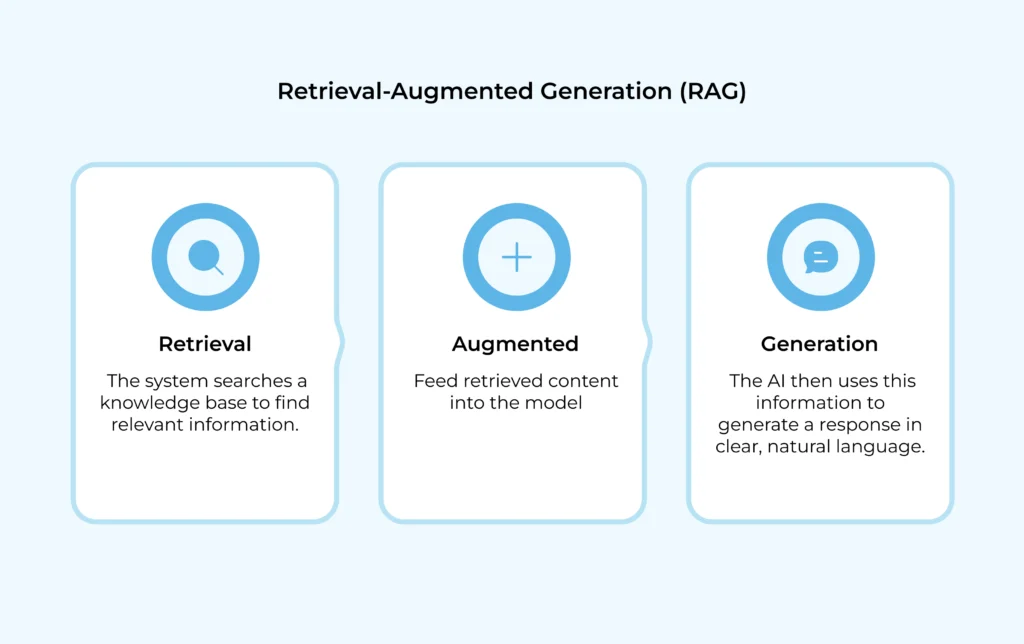
At its heart, RAG combines two capabilities: retrieval and generation.

    • Retrieval: The AI first searches a trusted knowledge source, like a database, company documents, or a vector store, to find the most relevant information.
    • Generation: Once the facts are retrieved, the AI generates a natural, conversational response based on that information.

This makes RAG a hybrid approach. Instead of relying only on what the model learned during training, it can now “look things up” before answering—just like how humans check a book, a website, or notes before responding.

An Analogy to Make It Simple

Imagine you’re in a library and someone asks you a question: “What’s the process to renew a passport?”

    • Without RAG, you’d rely on memory alone. You might remember most of the details, but you could mix up timelines, forms, or requirements.
    • With RAG, you’d first pull the official government handbook from the shelf (retrieval), then explain the process clearly in your own words (generation).

That’s exactly how RAG works—accuracy from facts, combined with the fluency of AI language models.

How RAG Works (Step by Step)
How RAG Works
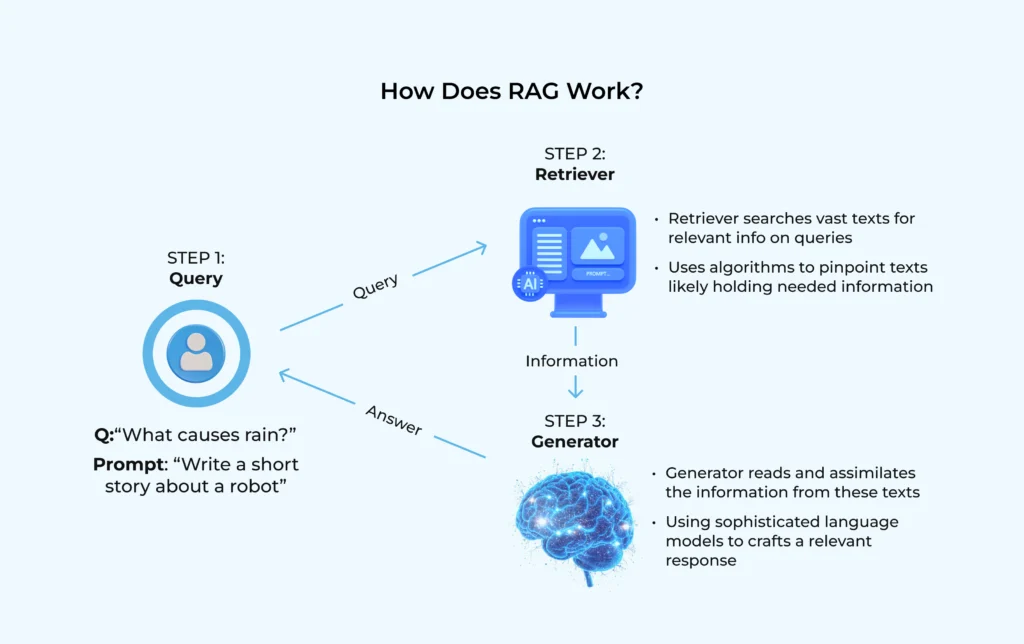
To understand RAG more deeply, let’s break down the workflow:

    • User Query: The process begins when a user asks a question, like “What’s the return policy for electronics?”
    • Encoding and Search: The question is turned into a vector (a mathematical representation of its meaning). This vector is used to search a vector database that stores all company documents in the same format.
    • Retriever Stage: The system pulls out the most relevant snippets or chunks of text, such as the section of a policy document that covers returns.
    • Generator Stage: A language model takes those snippets and writes a clear, context-rich response in natural language.
    • Final Answer: The user sees a reliable answer grounded in real company data, not a guess.

This process takes milliseconds but ensures that answers are both accurate and well-explained.

Why RAG Matters for AI
Why RAG Matters for AI
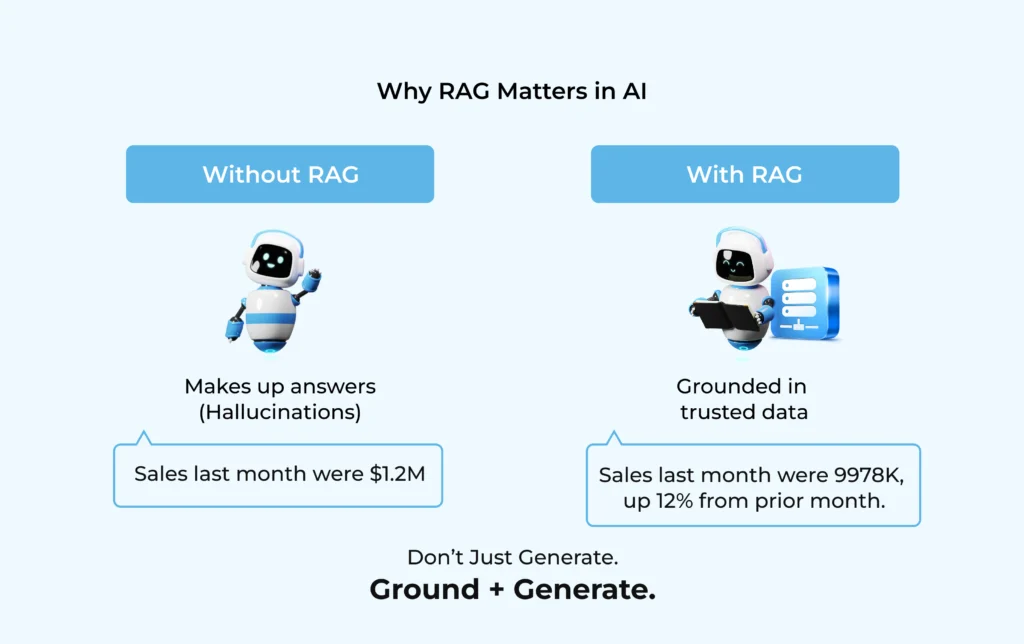
The rise of RAG is not just a technical improvement—it’s a shift in how AI can be trusted in real-world use cases.

    • Accuracy: By grounding answers in facts, RAG reduces the chances of hallucination.
    • Customization: Instead of answering with generic internet knowledge, AI can use your specific data—your policies, your manuals, your research papers.
    • Cost Efficiency: Unlike fine-tuning, where you retrain a whole model, RAG lets you plug in new data easily without modifying the core model.
    • Scalability: RAG works across domains—from customer support bots that answer questions using FAQs to enterprise assistants that search millions of documents instantly.

A Practical Example
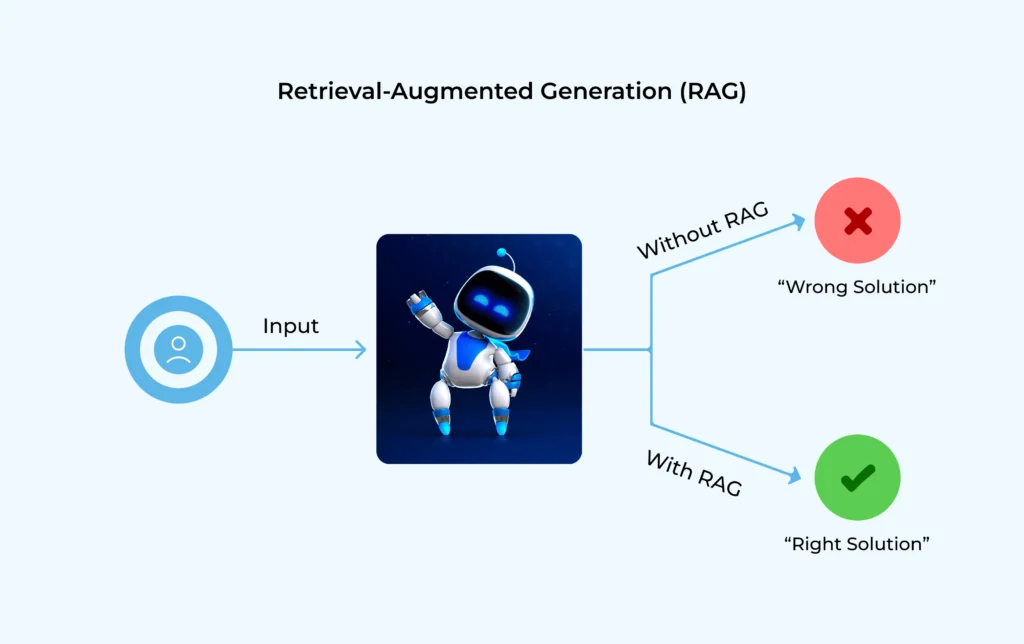
A Practical Example of RAG in Action

Let’s take an airline customer support chatbot as an example.

    • A passenger asks: “Can I carry a power bank in my luggage?”
    • Without RAG, a standard LLM might respond: “Yes, you can check it in.” ❌ Wrong and potentially dangerous.
    • With RAG, the system retrieves the official baggage policy from the airline’s database and generates the correct response:
      “According to airline policy, power banks are only allowed in hand baggage, not in checked luggage.” ✅

This is the difference between an AI that “sounds smart” and an AI that’s actually useful and reliable.

Where RAG is Being Used Today

RAG isn’t just a theory—it’s already powering real-world applications across industries:

    • Healthcare: Helping doctors and patients find accurate information from medical guidelines.
    • Finance: Assisting banks in answering customer queries with up-to-date compliance rules.
    • Legal: Providing lawyers with case summaries grounded in actual documents, not hallucinated examples.
    • Enterprise Search: Allowing employees to query internal company knowledge bases without reading through hundreds of PDFs.

The Takeaway

RAG is one of the most practical innovations in AI today. By combining retrieval (facts) and generation (language), it makes AI systems not just smarter, but also more trustworthy.

Think of it as giving AI the ability to look things up before speaking—something we humans naturally do. This simple shift has huge implications for businesses and users alike.

RAG turns AI from a “best guess machine” into a knowledge-powered assistant you can rely on.

Unlock Smarter AI with RAG


AI/ML technology specialist developing innovative software solutions. Expert in machine learning algorithms for enhanced functionality. Builds cutting-edge solutions for complex business challenges.

Jash Mathukiya

Application Developer

FAQs for

FAQs for: What is RAG in AI? A Beginner's Guide
What does RAG stand for and what does it do?
RAG stands for Retrieval-Augmented Generation. It is a technique for making AI chatbots and assistants more accurate by giving them access to a specific knowledge base before they answer questions. Without RAG, an AI only knows what it learned during training. With RAG, before answering your question, the AI first searches your documents, knowledge base, or database for relevant information — then uses what it finds to inform its answer. Think of it as giving the AI the ability to look things up rather than relying purely on memory.
Why do LLMs hallucinate and how does RAG fix it?
LLMs hallucinate because they generate responses based on patterns learned during training — they predict the most statistically likely next words, which sometimes produces confident-sounding text that is factually wrong. They have no mechanism to verify claims against ground truth. RAG reduces hallucination by constraining the LLM to answer from retrieved source documents: instead of generating freely from patterns, the LLM is instructed to answer only using the provided context. If the answer isn't in the retrieved documents, a well-configured RAG system will say 'I don't have information on that' rather than fabricating an answer.
What is a real-world example of RAG in action?
A company deploys a customer service chatbot trained on their product documentation, return policies, and support articles (stored in a vector database). When a customer asks 'Can I return a product bought 45 days ago?', the RAG system: (1) converts the question to a vector, (2) searches the vector database and retrieves the relevant return policy document ('Standard return window is 30 days; exceptions apply for defective items'), (3) passes the policy text to the LLM as context, (4) the LLM generates: 'Our standard return window is 30 days from purchase. If the item was defective, exceptions may apply — please contact support with your order number.' The answer is accurate, specific, and citable — impossible without RAG.
Do I need technical knowledge to implement RAG?
Basic RAG implementations are accessible to technical users with Python experience — frameworks like LangChain and LlamaIndex provide high-level abstractions that handle embedding, vector database operations, and LLM prompting with relatively few lines of code. Production-grade RAG systems (optimal chunking strategies, reranking, evaluation pipelines, monitoring) require deeper ML engineering expertise. Cloud providers including Azure (Azure AI Search + Azure OpenAI), AWS (Bedrock Knowledge Bases), and Google Cloud (Vertex AI Search) offer managed RAG services that reduce implementation complexity for teams without deep ML expertise.
What types of documents can be used in a RAG knowledge base?
RAG knowledge bases can contain almost any text-based content: PDF documents (product manuals, policy documents, research papers), Word and PowerPoint files, web pages and blog articles, database content (FAQs, product catalogs, customer records), email and chat history, code repositories, and structured data converted to text. The key requirement is that content must be processable into text chunks that can be embedded as vectors. Images within documents are handled by multimodal models (GPT-4V, Claude Vision) that can convert visual content to text descriptions before embedding.
How is RAG different from fine-tuning an LLM?
Fine-tuning modifies the LLM's internal parameters by training it further on domain-specific data — the knowledge becomes part of the model itself. RAG keeps the LLM unchanged and instead provides relevant knowledge at query time through retrieval. Practical difference: if your product catalog changes quarterly, fine-tuning requires retraining the model each quarter (expensive, time-consuming), while RAG only requires updating the vector database with new documents (fast, cheap). RAG also provides source citations for answers (the retrieved documents), while fine-tuned models generate from internalized knowledge with no explicit source reference.

Still Have Questions?

Can’t find the answer you’re looking for? Please get in touch with our team.

We Empower 170+ Global Businesses

Mars Logo
Johnson Logo
Kimberly Clark Logo
Coca Cola Logo
loreal logo
Jabil Logo
Hitachi Energy Logo
SkyWest Logo

Let’s innovate together!

Engage with a premier team renowned for transformative solutions and trusted by multiple Fortune 100 companies. Our domain knowledge and strategic partnerships have propelled global businesses.
Let’s collaborate, innovate and make technology work for you!

Our Locations

101 E Park Blvd, Plano,
TX 75074, USA

1304 Westport, Sindhu Bhavan Marg,
Thaltej, Ahmedabad, Gujarat 380059, INDIA

Phone Number

+1 817 380 5522


    Loading...

    Area Of Interest *

    Explore Our Service Offerings

    Hire A Team / Developer

    Become A Technology Partner

    Job Seeker

    Other