













What Kernshell Builds: Data Governance Solutions for Enterprise

Transform enterprise data into a secure, governed, and trusted business asset with scalable Data Governance solutions engineered for compliance, visibility, and operational control.

Data Governance Solutions for Enterprise

Our Data Governance Capabilities Include:

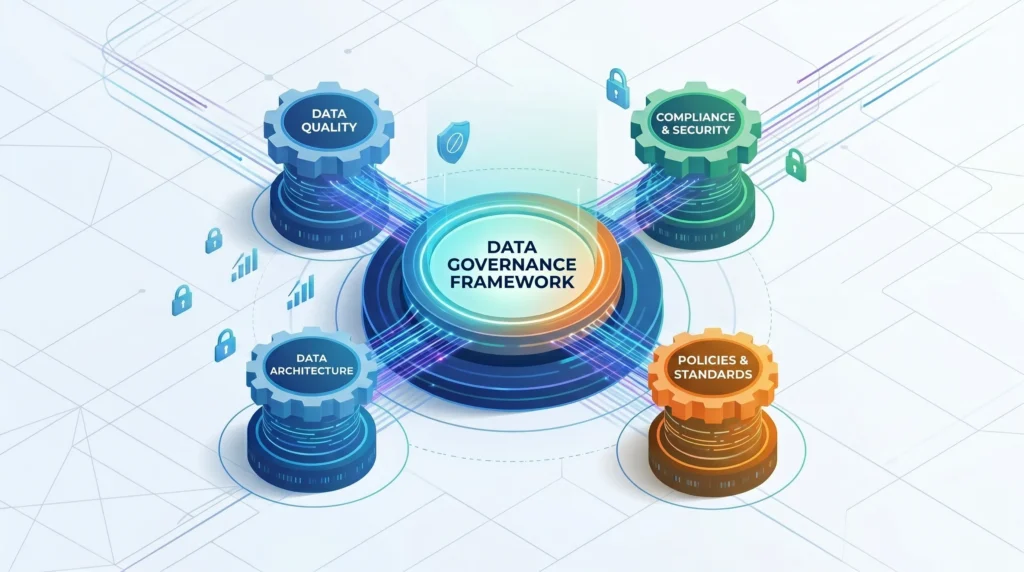
  • Enterprise Data Governance Frameworks for policy, ownership, and control
  • Data Quality Management improving accuracy, consistency, and reliability
  • Master Data Management (MDM) for unified enterprise data operations
  • Data Lineage & Metadata Management for visibility and auditability
  • Data Security & Access Governance with role-based control and compliance policies
  • Regulatory Compliance Solutions aligned to GDPR, HIPAA, SOC 2, and enterprise standards

From governance strategy and architecture to implementation and operational monitoring, Kernshell helps enterprises establish scalable Data Governance frameworks that support compliance, analytics, AI readiness, and long-term business trust.

End-to-End Data Governance Services We Offer

AI Data Quality Engineering

Data profiling, quality rule implementation, validation pipelines, anomaly detection, and remediation workflows – quality assessed at source, transformation, and consumption layers, ensuring AI models and BI platforms are never built on unreliable data.

Data Lineage & Traceability

End-to-end lineage from source ingestion through transformation to model output – using Apache Atlas, Microsoft Purview, dbt lineage, and MLflow. Full lineage graphs enabling root cause analysis and regulatory audit evidence without manual documentation effort.

Data Governance Framework Design

Data ownership structures, stewardship responsibilities, classification frameworks, data cataloguing, and policy enforcement – operationalised across your teams and integrated into workflows. Governance that functions in practice, not just in policy documents.

RBAC & Data Access Controls

Role-based access control governing who accesses, modifies, and exports data – with fine-grained permission management, access logging, privilege review, and segregation of duties controls aligned to your security policies and regulatory obligations.

Regulatory Compliance Architecture

Technical controls for GDPR Article 5, CCPA consumer rights, HIPAA Privacy and Security Rules, and SOC 2 – data residency, consent management, purpose limitation, and documentation structured for regulatory submission and audit response.

AI Bias Detection & Fairness Evaluation

Bias auditing at three stages – training data, model outputs, and production monitoring – across protected characteristics using demographic parity, equalised odds, and calibration metrics. Bias remediated before any model proceeds to production.

Explainable AI (XAI) Data Governance

SHAP and LIME explainability connected to your governance framework – every AI decision traceable to its data inputs and model reasoning, structured for internal audit, regulatory submission, and end-user communication.

Data Privacy Engineering

Data minimisation, PII detection and redaction, pseudonymisation, anonymisation, and privacy-by-design across AI pipelines – personal and sensitive data handled in strict compliance with GDPR, HIPAA, and CCPA throughout training and inference.

MLOps & Databricks Governance Integration

Quality gates before model training, data lineage through MLflow and Databricks, fairness evaluation at model promotion, and compliance documentation at deployment – governance as a technical pipeline constraint, not a post-deployment review.

AI Data Platform Modernisation

Migration to Snowflake, Databricks, Azure Synapse, AWS Redshift, or Google BigQuery – with lineage, quality frameworks, access controls, and compliance documentation implemented during migration, not added retrospectively.

Our AI Data & Governance Technology Stack

Production-proven platforms selected based on your cloud environment, existing data infrastructure, and compliance requirements.

  • All
  • Languages
  • Gen AI platforms
  • Frameworks
  • Debugging & Tracing
  • Vector Databases
  • DBMS
  • Data Visualization

Languages

C#

C#

Rust

Rust

Python

Python

JavaScript

JavaScript

Java

Java

R

R

Gen AI platforms

LangChain

LangChain

Hugging Face

Hugging Face

Apache Spark

Apache Spark

Gemini

Gemini

Phi

Phi

Frameworks

LangChain

LangChain

LlamaIndex

LlamaIndex

PyTorch

PyTorch

Kedro

Kedro

TensorFlow

TensorFlow

Keras

Keras

Debugging & Tracing

Langsmith

Langsmith

Langfuse

Langfuse

Vector Databases

PostgreSQL

PostgreSQL

Chroma

Chroma

Milvus

Milvus

Qdrant

Qdrant

Pinecone

Pinecone

DBMS

PostgreSQL

PostgreSQL

MySQL

MySQL

MongoDB

MongoDB

CouchDB

CouchDB

Cassandra

Cassandra

Neo4j

Neo4j

Data Visualization

Power BI

Power BI

Tableau

Tableau

Languages

C#

C#

Rust

Rust

Python

Python

JavaScript

JavaScript

Java

Java

R

R

Gen AI platforms

LangChain

LangChain

Hugging Face

Hugging Face

Apache Spark

Apache Spark

Gemini

Gemini

Phi

Phi

Frameworks

LangChain

LangChain

LlamaIndex

LlamaIndex

PyTorch

PyTorch

Kedro

Kedro

TensorFlow

TensorFlow

Keras

Keras

Debugging & Tracing

Langsmith

Langsmith

Langfuse

Langfuse

Vector Databases

PostgreSQL

PostgreSQL

Chroma

Chroma

Milvus

Milvus

Qdrant

Qdrant

Pinecone

Pinecone

DBMS

PostgreSQL

PostgreSQL

MySQL

MySQL

MongoDB

MongoDB

CouchDB

CouchDB

Cassandra

Cassandra

Neo4j

Neo4j

Data Visualization

Power BI

Power BI

Tableau

Tableau

Ready To Build AI Your Organisation Can Trust And Scale?

Image
Image

Data Governance By Industry

Data Governance Solutions We Can Design, Build & Operate

Proven AI data governance solution patterns – purpose-engineered for enterprise compliance obligations, data environments, and AI programme maturity.

Data & Governance Services
Enterprise AI Data Quality Platform

End-to-end data quality infrastructure - profiling, rules, validation pipelines, anomaly detection, and remediation - deployed as quality gates before every model training run and production data serving cycle across your data platform.

Data Lineage & Catalogue Implementation

Enterprise lineage system and catalogue - Apache Atlas, Microsoft Purview, or OpenMetadata - capturing source-to-output lineage across data pipelines, ML workflows, and AI systems. Every dataset, transformation, and model artefact catalogued and audit-ready.

GDPR / HIPAA / CCPA Compliance Architecture

Data minimisation, consent management, purpose limitation, PII detection and redaction, data residency, and regulatory documentation - embedded into pipelines, not applied as periodic review checklists.

AI Bias Monitoring & Fairness Platform

Continuous bias evaluation across model inputs, outputs, and decision distributions - automated alerting when fairness metrics breach thresholds, SHAP explainability for audit requests, and retraining triggers when remediation is required.

Data Access Governance & RBAC Implementation

Granular access permissions across data assets, model artefacts, feature stores, and pipeline configurations - full audit logging, quarterly privilege reviews, and segregation of duties controls aligned to your security policies.

MLOps Governance Integration

Data quality gates before training, lineage through MLflow and Databricks, fairness checkpoints at model promotion, and compliance documentation at deployment - governance as a pipeline component, not a manual review overlay.

AI Data Platform Migration with Governance

Governed migration to Snowflake, Databricks, Azure Synapse, or cloud platforms - lineage, quality frameworks, access controls, and compliance documentation implemented during migration, not as a post-migration layer.

Responsible AI Assessment & Remediation

Structured assessment of existing AI systems - bias evaluation, lineage audit, explainability gap analysis, compliance control review - producing a prioritised remediation roadmap with phased implementation milestones.


Our Process For Data Governance Implementation

A five-stage process – from governance assessment to production-embedded data controls – with defined outputs at every stage.

AI Data Governance Assessment

Current state audit of data quality, lineage coverage, access controls, compliance gaps, and regulatory obligations – gap analysis and prioritised governance roadmap produced before any infrastructure work begins.

Data Governance Assessment
Framework Design & Architecture

Data governance policies, ownership structures, classification frameworks, RBAC architecture, compliance controls, and technical platform design – framework documented and reviewed before implementation begins.

Technical Implementation

Quality pipeline deployment, lineage system implementation, RBAC rollout, PII detection pipelines, bias monitoring infrastructure, and MLOps governance integration – built and validated against your production data environment and compliance requirements.

Technical Implementation
Compliance Documentation & Audit Readiness

Data policies, processing records, lineage evidence, bias evaluation reports, access documentation, and model governance evidence – structured for GDPR, HIPAA, SEC, FCA, and ISO regulatory submission and internal audit response.

Ongoing Governance & Monitoring

Continuous quality monitoring, access review cycles, bias monitoring, lineage maintenance, regulatory update tracking, and governance maturity reviews – sustained as your AI portfolio scales and regulatory requirements evolve.

Ongoing Governance & Monitoring

Why Enterprises Choose Us For Data Governance

AI data governance demands regulatory expertise, data engineering capability, and ML production experience – compliance consultants without technical depth cannot deliver what enterprise AI programmes require.

  • Engineering-led AI data governance with quality controls, lineage tracking, bias monitoring, and access management embedded directly into data and ML pipelines.

  • Proven governance delivery across financial services, healthcare, manufacturing, and energy where regulatory exposure and operational risk demand enterprise-grade controls.
  • Deep integration expertise across Databricks, Snowflake, Azure Machine Learning, and AWS SageMaker without requiring platform replacement or parallel governance stacks.
  • Vendor-independent governance tooling assessment across Apache Atlas, Microsoft Purview, Collibra, Great Expectations, Monte Carlo, and related ecosystems.
  • Compliance-first implementation approach with audit trails, policy enforcement, RBAC, data quality validation, and observability built into operational workflows.
  • Governance frameworks engineered for both current regulatory requirements and future AI portfolio expansion without creating operational bottlenecks.
  • End-to-end ownership spanning governance assessment, framework design, technical implementation, compliance documentation, and continuous monitoring.
Data Analytics Kernshell
Don't Worry!

Our expert will solve your queries in one call.

Client Triumphs: Success Stories

Discover how our team of domain specialists have addressed industry-specific challenges and mission-critical needs. Turning your Vision into Victory, One Success Story at a time!

Kernshell AI Services FAQ

Have a question? We’re here to help.

What is AI data governance and why does enterprise AI require it?

AI data governance manages data quality, lineage, access, compliance, and ethical standards across the pipelines and datasets powering AI. Without it, enterprises deploy AI on unreliable data – producing inaccurate models, compliance violations, biased outputs, and audit failures significantly more expensive to remediate after production than to prevent through governance embedded at the data layer from the outset.

How does Kernshell approach data lineage and traceability for AI systems?

End-to-end lineage from source ingestion through every transformation to model output – using Apache Atlas, Microsoft Purview, dbt lineage, and MLflow. Full lineage graphs enable root cause analysis and generate regulatory audit evidence without manual effort. For ML systems, lineage is tracked at the experiment, training run, and deployment level – every production model traceable to its exact training data and feature pipeline version.

Does Kernshell build HIPAA-compliant AI data systems?

Yes. HIPAA Privacy and Security Rule controls are architected from the first design decision – de-identification, minimum necessary access, encrypted transmission and storage, BAA-aligned data handling, access audit logging, and breach notification-ready incident documentation. All clinical AI data systems are delivered with governance documentation meeting FDA SaMD and HIPAA audit requirements.


How does Kernshell approach AI bias detection and fairness evaluation?

Bias audits at three stages – training data, model outputs, and production monitoring – across protected characteristics using demographic parity, equalised odds, and calibration metrics. Remediated through dataset rebalancing, constraint-based training, or post-processing corrections – validated before any model proceeds to production. Production monitoring implemented as an automated pipeline component with configurable alerting.

What is the difference between data governance and AI governance?

Data governance manages quality, lineage, access, and compliance of data assets across an organisation. AI governance extends this to address AI-specific risks – model bias, algorithmic explainability, automated decision-making accountability, and AI-specific regulatory compliance including EU AI Act and FDA SaMD. Kernshell builds both as an integrated capability – AI governance built on a governed data foundation, not implemented as a separate overlay.

How does Kernshell handle GDPR compliance for AI data systems?

Data minimisation limiting personal data in training pipelines, purpose limitation preventing use beyond consented scope, pseudonymisation and anonymisation for training data, data subject rights implementation connected to AI training data registries, and Article 22 automated decision-making documentation – all implemented as technical pipeline components with documentation structured for DPA submission.

How long does an AI data governance implementation take?

A focused implementation – data quality framework, RBAC deployment, and lineage system for an existing AI platform – completes in 8–12 weeks. A full enterprise programme covering quality, lineage, compliance architecture, bias monitoring, MLOps integration, and regulatory documentation is typically 16–24 weeks depending on AI portfolio size, platform complexity, and regulatory obligations. Both are structured with clear milestones following the governance assessment.

Still Have Questions?

Can’t find the answer you’re looking for? Please get in touch with our team.

We Empower 170+ Global Businesses

Mars Logo
Johnson Logo
Kimberly Clark Logo
Coca Cola Logo
loreal logo
Jabil Logo
Hitachi Energy Logo
SkyWest Logo

Let’s innovate together!

Engage with a premier team renowned for transformative solutions and trusted by multiple Fortune 100 companies. Our domain knowledge and strategic partnerships have propelled global businesses.
Let’s collaborate, innovate and make technology work for you!

Our Locations

101 E Park Blvd, Plano,
TX 75074, USA

1304 Westport, Sindhu Bhavan Marg,
Thaltej, Ahmedabad, Gujarat 380059, INDIA

Phone Number

+1 817 380 5522


    Loading...

    Area Of Interest *

    Explore Our Service Offerings

    Hire A Team / Developer

    Become A Technology Partner

    Job Seeker

    Other