













- Services
-
-
- Service Platform
Artificial Intelligent
AI, ML & Data Engineering
End-to-end digital services spanning AI, data, development, cloud, and design.
ETQ Reliance
Enterprise Platforms
Migrate, manage, deploy, and optimize M365, Azure, Power Platform, and Microsoft Teams
Software Development
Mobile & Web
UI/UX Design
Software Testing & QA
Digital Engineering
End-to-end digital services spanning AI, data, development, cloud, and design.
Cloud Infrastructure
DevOps & Automation
Cloud
Migrate, manage, deploy, and optimize M365, Azure, Power Platform, and Microsoft Teams
Security Engineering
Risk & Compliance
Cybersecurity
Security engineering, compliance, and risk management
-
-
- Industries & Customers
- Solutions
-
-
Solutions
End-to-end IT solutions to transform, manage, and scale your digital ecosystem.
-
-
- Insights
-
- Company
-
Security Testing Services Find Vulnerabilities Before Attackers Do
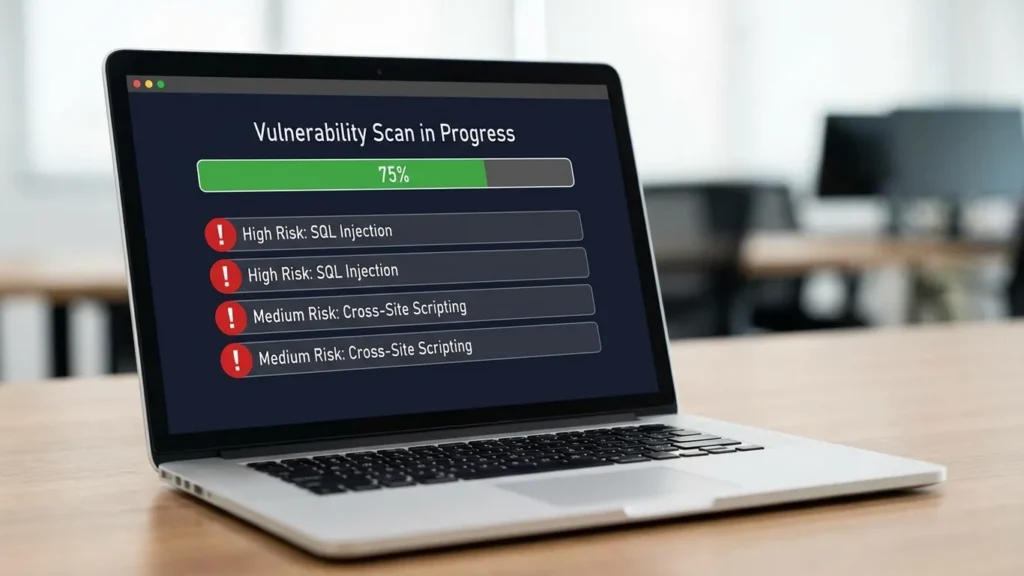
Kernshell delivers enterprise security testing – including penetration testing, VAPT, web and mobile application security, API security assessments, cloud security reviews, and compliance validation. Aligned with OWASP, NIST, PTES, GDPR, HIPAA, PCI DSS, and SOC 2 requirements.
What Kernshell Builds: Security Testing Services for Enterprise
Transform application security and risk management with enterprise security testing solutions engineered for resilience, compliance, and operational protection.
Our Security Testing Capabilities Include:
- Vulnerability Assessment & Penetration Testing identifying exploitable security weaknesses across applications and infrastructure
- API & Web Application Security Testing improving protection against modern cyber threats
- Cloud & Infrastructure Security Validation across hybrid and enterprise cloud environments
- Authentication & Access Control Testing ensuring secure identity and permission management
- DevSecOps Security Integration embedding security validation into CI/CD and release workflows
- Compliance & Security Reporting aligned to SOC 2, ISO 27001, HIPAA, GDPR, and enterprise governance standards
From security assessment and risk analysis to remediation guidance and continuous validation, Kernshell helps enterprises operationalize security testing frameworks that improve cyber resilience, compliance readiness, and enterprise-wide digital security posture.
End-to-End Security Testing Services We Offer
Web Application Penetration Testing
Manual web application penetration testing aligned to OWASP WSTG, covering authentication, access control, injection, misconfiguration, cryptography, SSRF, and business logic flaws. Findings are validated through controlled exploitation, reducing false positives and demonstrating real risk.
API Security Testing
API security testing for REST, GraphQL, and SOAP services, covering authentication, authorisation, BOLA/IDOR, data exposure, rate limiting, injection, mass assignment, and insecure design. Aligned to the OWASP API Top 10, with manual validation of business logic risks.
Mobile Application Security Testing
Mobile application security testing for iOS and Android aligned to OWASP MASVS, covering data storage, transport security, authentication, communications, tampering, reverse engineering, and binary protection. Testing is performed on physical devices to identify real-world mobile security risks.
Cloud Security Assessment
Cloud security assessments for AWS, Azure, and Google Cloud covering IAM risks, exposed resources, network misconfigurations, secrets management, logging, encryption, and cloud service settings. Aligned to CIS Benchmarks and provider security best practices across your infrastructure estate.
Infrastructure Penetration Testing
Internal and external network penetration testing covering reconnaissance, service enumeration, exploitation, lateral movement, privilege escalation, and Active Directory attack paths. Assessments simulate real-world attacker scenarios and provide documented exploitation chains demonstrating business impact.
Vulnerability Assessment & Penetration Testing
Combined VAPT combining automated scanning with manual validation, exploitation, and business impact analysis. Covers web applications, APIs, infrastructure, or cloud environments, delivering a risk-prioritised report with verified findings and actionable remediation guidance.
Secure Code Review
Manual secure code review covering authentication, authorisation, cryptography, input validation, secrets handling, dependencies, and architecture risks. Supports Java, .NET, Python, JavaScript/TypeScript, PHP, Go, Swift, and Kotlin, identifying vulnerabilities before deployment.
Social Engineering & Phishing Assessment
Security awareness assessments through controlled phishing, pretexting, and vishing simulations. Measures click, credential submission, and reporting rates to identify high-risk user groups, evaluate human security controls, and target awareness training where it will have the greatest impact.
Red Team Exercise
Red team exercises simulating sophisticated multi-vector attacks across people, processes, and technology. Evaluates detection, response, and containment capabilities under realistic conditions, measuring operational resilience rather than simply identifying technical vulnerabilities.
Compliance Security Testing
Security assessments aligned to PCI DSS, HIPAA, GDPR, SOC 2, ISO 27001, and DORA requirements. Produces audit-ready evidence, technical findings, and compliance documentation to support certifications, regulatory reviews, client due diligence, and security questionnaires.
Our Security Testing Technology & Methodology Stack
Industry-standard methodologies and professional-grade tooling – applied by security engineers with production exploitation experience, not automated by tools without human verification.
- All
- Languages
- Gen AI platforms
- Frameworks
- Debugging & Tracing
- Vector Databases
- DBMS
- Data Visualization
Languages
C#
Rust
Python
JavaScript
Java
R
Gen AI platforms
LangChain
Hugging Face
Apache Spark
Gemini
Phi
Frameworks
LangChain
LlamaIndex
PyTorch
Kedro
TensorFlow
Keras
Debugging & Tracing
Langsmith
Langfuse
Vector Databases
PostgreSQL
Chroma
Milvus
Qdrant
Pinecone
DBMS
PostgreSQL
MySQL
MongoDB
CouchDB
Cassandra
Neo4j
Data Visualization
Power BI
Tableau

Languages
C#
Rust
Python
JavaScript
Java
R
Gen AI platforms
LangChain
Hugging Face
Apache Spark
Gemini
Phi
Frameworks
LangChain
LlamaIndex
PyTorch
Kedro
TensorFlow
Keras
Debugging & Tracing
Langsmith
Langfuse
Vector Databases
PostgreSQL
Chroma
Milvus
Qdrant
Pinecone
DBMS
PostgreSQL
MySQL
MongoDB
CouchDB
Cassandra
Neo4j
Data Visualization
Power BI
Tableau

Where Security Testing Delivers Enterprise-Grade Impact Across Functions
IT Security & CISO
Software Engineering & Development
Compliance & Legal
Finance & Risk Management
Operations & Infrastructure
Product & Engineering Leadership
Human Resources & Awareness
Board & Executive
Security Testing Solutions We Can Design, Conduct & Report
Proven security testing engagement models – scoped and structured for the application types, infrastructure complexity, and compliance requirements of enterprise organisations.
Enterprise Web Application Penetration Test
Manual web application penetration testing aligned to OWASP WSTG, covering authentication, access control, injection, session management, business logic, and cryptographic controls. Includes exploitation evidence, risk-ranked findings, and remediation guidance for release or compliance assurance.
API Security Assessment
API security testing for REST and GraphQL services covering OWASP API Top 10 risks, authentication, authorisation, BOLA/IDOR, rate limiting, mass assignment, and business logic flaws. Delivered standalone or as part of a full application security assessment.
Cloud Security Posture Assessment
AWS, Azure, or GCP security assessments covering IAM risks, exposed resources, encryption, logging, monitoring, network controls, and CIS Benchmark compliance. Delivers prioritised findings with clear remediation actions to reduce cloud security exposure.
Infrastructure & Network Penetration Test
External and internal network penetration testing simulating remote attackers, compromised hosts, and insider threats. Covers Active Directory attack paths, service exploitation, lateral movement, and privilege escalation, with documented attack chains and remediation guidance.
Mobile Application Security Assessment
iOS and Android security testing aligned to OWASP MASVS, covering data storage, communications, authentication, code resilience, and API security. Includes physical device testing, dynamic analysis, binary protection review, and app store compliance validation.
Secure Development Lifecycle (SDL) Integration
Shift-left security integrated across the SDLC with threat modelling, secure code reviews, DAST in CI/CD, and pre-release penetration testing. Identifies vulnerabilities early, reducing remediation cost, release risk, and security debt before production deployment.
PCI DSS Penetration Testing Programme
PCI DSS Requirement 11.3 penetration testing covering external and internal networks, cardholder data environments, segmentation controls, and payment applications. Includes compliance-ready reporting structured for PCI DSS evidence submission and QSA review.
Red Team Adversarial Simulation
Multi-vector red team exercises combining phishing, physical access, application attacks, and infrastructure compromise. Measures detection, response, and resilience under realistic attack conditions, exposing gaps between assumed security posture and actual defensive capability.
Our Process For Security Testing Engagements
A six-stage process – from scope definition to remediation validation – with transparent communication and evidence-based findings at every stage.
Scoping & Rules of Engagement
Engagement scope definition, target system identification, testing window agreement, rules of engagement documentation, out-of-scope boundary specification, emergency contact protocol, and legal authorisation documentation – every parameter agreed and documented before any testing activity begins.
Reconnaissance & Threat Modelling
Passive and active reconnaissance of defined scope – attack surface mapping, technology stack fingerprinting, exposed service enumeration, known vulnerability identification, and threat model development. Testing approach prioritised based on highest-risk attack vectors for your specific application architecture, technology stack, and business context.
Active Security Testing & Exploitation
Manual penetration testing and exploitation – vulnerability identification, exploitation attempt, privilege escalation, lateral movement (where in scope), and business impact demonstration. Every critical and high finding documented with reproduction steps, exploitation evidence, and demonstrated business impact before testing concludes.
Analysis, Risk Prioritisation & Report Production
Vulnerability analysis, CVSS v3.1 scoring, business impact assessment, regulatory exposure mapping, false positive elimination, and findings report production — executive summary and technical detailed findings delivered within agreed reporting SLA.
Findings Presentation & Remediation Guidance
Findings presentation to security, engineering, and executive stakeholders — technical vulnerability walkthrough for development teams, executive risk summary for leadership, and remediation prioritisation guidance based on exploitability, business impact, and remediation effort. Developer-facing remediation guidance written for implementation, not for compliance record-keeping.
Remediation Validation & Re-Testing
Re-testing of remediated vulnerabilities – confirmed fix validation for every critical and high finding, partial remediation assessment for medium and low findings, and remediation validation certificate issued for compliance submission. Fixes verified by the same security engineers who identified the vulnerability – not assumed from development team confirmation alone.
Why Enterprises Choose Us For Security Testing
The difference between a security testing vendor and a security testing partner is whether they find the vulnerabilities that matter for your specific environment – or deliver automated scanner output wrapped in a professional report.
- Expert-led penetration testing performed by security engineers with deep application, infrastructure, and architecture experience.
- Comprehensive security assessments covering web, API, mobile, cloud, network, and secure code review.
- Proven experience supporting regulated industries with GDPR, HIPAA, PCI DSS, SOC 2, and ISO 27001 security requirements.
- Business-focused reporting that translates technical vulnerabilities into operational, financial, and compliance risks.
- Security integrated across the development lifecycle through secure code reviews, SDL practices, and continuous testing.
- End-to-end ownership covering assessment, testing, reporting, remediation guidance, and validation of fixes.
Our expert will solve your queries in one call.
Client Triumphs: Success Stories
Discover how our team of domain specialists have addressed industry-specific challenges and mission-critical needs. Turning your Vision into Victory, One Success Story at a time!
FAQs on Security Testing
Have a question? We’re here to help.
End-to-end security testing – web application penetration testing, API security assessment, mobile application security testing (iOS and Android), cloud security posture assessment (AWS, Azure, GCP), infrastructure and network penetration testing, vulnerability assessment and penetration testing (VAPT), secure code review, social engineering and phishing assessment, red team adversarial simulation, and compliance-aligned security testing for PCI DSS, HIPAA, GDPR, SOC 2, and ISO 27001. Delivered for Fortune 500 enterprises across manufacturing, financial services, healthcare, energy, logistics, and retail.

A vulnerability assessment systematically identifies and catalogues known vulnerabilities in a defined scope – primarily through automated scanning tools validated by manual review — producing a prioritised inventory of vulnerabilities without attempting exploitation. A penetration test goes further – a security engineer attempts to actively exploit identified vulnerabilities to demonstrate real-world attack impact, chain multiple vulnerabilities into an attack path, and identify business logic vulnerabilities that automated tools cannot detect. Kernshell recommends penetration testing for applications handling sensitive customer data, financial transactions, or regulated health information – where demonstrated exploitability is required rather than theoretical risk identification.
Every web application penetration test follows OWASP Web Security Testing Guide methodology – covering authentication and session management, injection flaws, access control, security misconfiguration, cryptographic implementation, sensitive data exposure, server-side request forgery, and business logic vulnerabilities. Testing is conducted manually by security engineers, not by running automated scanners and presenting their output. Every critical and high-severity finding is accompanied by a working exploitation demonstration – reproduction steps, screenshots, HTTP request/response evidence, and business impact assessment – before the engagement concludes.
Production system protection is addressed through scoping and rules of engagement agreed before testing begins – specific systems, IP ranges, and testing windows defined, with out-of-scope boundaries documented and legally agreed. Destructive tests (DoS, data deletion, production data modification) are excluded from scope unless explicitly agreed. Testing conducted during agreed windows with emergency contact protocols enabling immediate testing suspension if unexpected production impact is observed. For business-critical production systems, testing is conducted on a production-equivalent staging environment first, with production testing limited to targeted, non-destructive validation of specific findings.
PCI DSS Requirement 11.3 annual penetration testing – external and internal penetration test of cardholder data environment with segmentation testing and QSA-structured report. HIPAA security safeguard technical assessment – access control, audit logging, transmission security, and integrity control validation. GDPR technical security measure assessment – encryption, access controls, and data protection by design validation. SOC 2 security control testing – availability, confidentiality, and security trust service criteria technical control evidence. ISO 27001 technical vulnerability management – A.12.6 compliance testing and evidence package production. All compliance security engagements produce reports structured for regulatory submission and audit response.
Sensitive data handling is governed by rules of engagement agreed before testing begins – specifically defining whether testers are authorised to access, capture, or store any data discovered during testing. Where test accounts and synthetic data cannot fully replicate production conditions, data handling procedures are defined: minimum necessary access, no data exfiltration to tester-controlled systems, secure deletion of any incidentally captured data, and immediate notification if unexpected sensitive data access occurs. For regulated environments – HIPAA, GDPR, PCI DSS – data handling procedures are aligned to the specific regulatory requirements applicable to the data classification of systems in scope.
A focused web application penetration test of a mid-complexity application typically completes testing in 5–10 business days with a report delivered within 3–5 business days of testing completion. An API security assessment adds 3–5 business days. A cloud security posture assessment typically requires 5–8 business days. An infrastructure penetration test scope determines duration – external perimeter tests typically 3–5 days, internal network assessments 5–10 days depending on network size and complexity. Red team exercises are typically 2–4 weeks. All engagement timelines are defined in the scoping agreement before testing begins – not estimated from scope descriptions before the technical architecture is understood.


Still Have Questions?
Can’t find the answer you’re looking for? Please get in touch with our team.
Let’s innovate together!
Engage with a premier team renowned for transformative solutions and trusted by multiple Fortune 100 companies. Our domain knowledge and strategic partnerships have propelled global businesses.
Let’s collaborate, innovate and make technology work for you!
Our Locations
101 E Park Blvd, Plano, TX 75074, USA
1304 Westport, Sindhu Bhavan Marg, Thaltej, Ahmedabad, Gujarat 380059, INDIA
Email Address