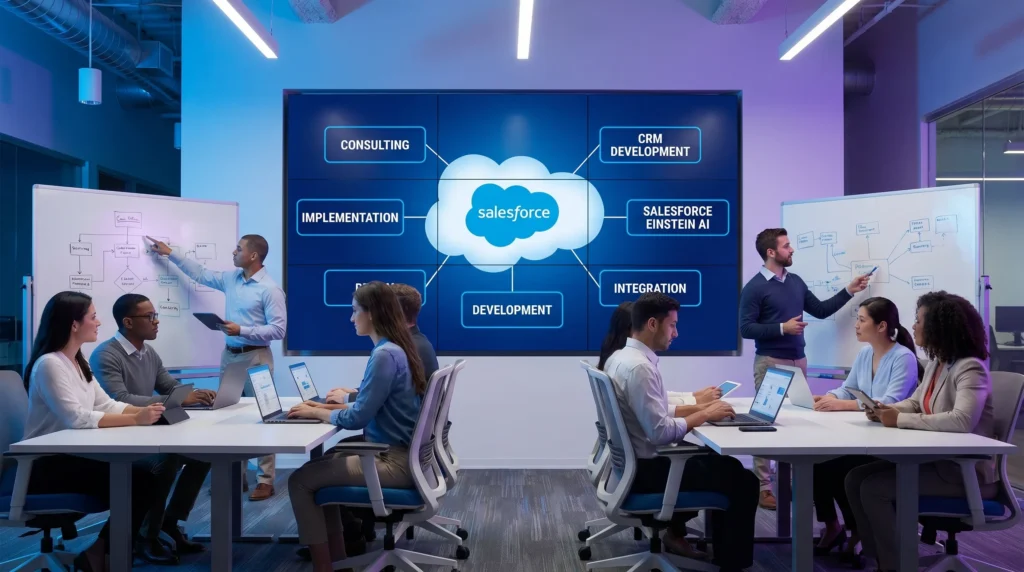














What Kernshell Builds: Salesforce Integration Services for Enterprise

Transform disconnected business systems into a unified enterprise ecosystem with Salesforce integration solutions engineered for scalability, automation, and operational visibility.

Our Salesforce Integration Capabilities Include:

  • Salesforce API Integration connecting ERP, CRM, finance, HR, and operational systems
  • Real-Time Data Synchronization improving business visibility and operational accuracy
  • Middleware & Integration Architecture for scalable enterprise connectivity
  • Microsoft 365 & Power Platform Integration enabling connected productivity ecosystems
  • Workflow Automation & Process Orchestration across enterprise applications and platforms
  • Secure Integration Governance with access control, monitoring, and compliance management

From integration strategy and architecture to deployment and optimization, Kernshell helps enterprises operationalize Salesforce integration ecosystems that improve efficiency, collaboration, and enterprise-wide operational performance.

End-to-End Salesforce Integration Services We Offer

MuleSoft Anypoint Platform Design & Development

API-led connectivity architecture, Mule application development, DataWeave transformation, error handling frameworks, and Anypoint Exchange cataloguing – building reusable integration assets that reduce future development cost and give IT leadership visibility across the entire integration landscape.

Salesforce REST & SOAP API Integration

Custom API integrations connecting Salesforce to third-party systems and internal applications – engineered with authentication frameworks, rate limit management, retry logic, payload validation, and error handling ensuring production reliability under enterprise transaction volumes.

Salesforce ERP Integration

Bi-directional integration between Salesforce and SAP S/4HANA, SAP ECC, Oracle ERP Cloud, Oracle E-Business Suite, and Microsoft Dynamics — synchronising accounts, contacts, orders, invoices, inventory, and pricing with field mapping governance, conflict resolution logic, and audit trail architecture.

Salesforce HRMS Integration

Automated synchronisation of employee records, organisational hierarchies, and role data between Salesforce and HRMS — keeping territory management, account ownership, and user provisioning accurate without manual administration overhead.

Marketing Cloud Connect & Data Integration

Marketing Cloud Connect configuration connecting Sales Cloud and Service Cloud data to journey orchestration – ensuring marketing automation operates on current CRM records and campaign engagement feeds back for pipeline attribution and lead scoring.

Platform Events & Event-Driven Architecture

Platform Events, Change Data Capture, and Streaming API enabling real-time event-driven integration – eliminating scheduled polling, reducing data latency, and decoupling integration dependencies for processes where timing is operationally critical.

Salesforce Connect & External Objects

Salesforce Connect exposing external system data as External Objects within Salesforce – giving teams real-time access to ERP, financial, and operational records within the CRM interface without data replication or synchronisation complexity.

Legacy System & Mainframe Integration

Middleware and file-based integration connecting Salesforce to legacy ERP, mainframe, and on-premises systems – custom adapters, FTP/SFTP pipelines, message queue integration, and batch synchronisation for landscapes where legacy modernisation is not an immediate option.

Salesforce Data Migration & ETL Integration

ETL pipeline development for initial data load, ongoing synchronisation, and legacy CRM migration – extraction, transformation, deduplication, validation, and controlled load with rollback capability and post-migration reconciliation reporting.

Integration Security & Compliance Architecture

OAuth 2.0 and JWT authentication, Named Credentials management, encrypted payload handling, data masking, data residency compliance, and PII protection – for regulated industries where governance requirements extend to every system boundary.

Our Core Salesforce Integration Technology Stack

Platforms, tools, and integration frameworks selected based on your operational requirements and data architecture – not partner incentive structures.

  • All
  • Languages
  • Gen AI platforms
  • Frameworks
  • Debugging & Tracing
  • Vector Databases
  • DBMS
  • Data Visualization

Languages

C#

C#

Rust

Rust

Python

Python

JavaScript

JavaScript

Java

Java

R

R

Gen AI platforms

LangChain

LangChain

Hugging Face

Hugging Face

Apache Spark

Apache Spark

Gemini

Gemini

Phi

Phi

Frameworks

LangChain

LangChain

LlamaIndex

LlamaIndex

PyTorch

PyTorch

Kedro

Kedro

TensorFlow

TensorFlow

Keras

Keras

Debugging & Tracing

Langsmith

Langsmith

Langfuse

Langfuse

Vector Databases

PostgreSQL

PostgreSQL

Chroma

Chroma

Milvus

Milvus

Qdrant

Qdrant

Pinecone

Pinecone

DBMS

PostgreSQL

PostgreSQL

MySQL

MySQL

MongoDB

MongoDB

CouchDB

CouchDB

Cassandra

Cassandra

Neo4j

Neo4j

Data Visualization

Power BI

Power BI

Tableau

Tableau

Languages

C#

C#

Rust

Rust

Python

Python

JavaScript

JavaScript

Java

Java

R

R

Gen AI platforms

LangChain

LangChain

Hugging Face

Hugging Face

Apache Spark

Apache Spark

Gemini

Gemini

Phi

Phi

Frameworks

LangChain

LangChain

LlamaIndex

LlamaIndex

PyTorch

PyTorch

Kedro

Kedro

TensorFlow

TensorFlow

Keras

Keras

Debugging & Tracing

Langsmith

Langsmith

Langfuse

Langfuse

Vector Databases

PostgreSQL

PostgreSQL

Chroma

Chroma

Milvus

Milvus

Qdrant

Qdrant

Pinecone

Pinecone

DBMS

PostgreSQL

PostgreSQL

MySQL

MySQL

MongoDB

MongoDB

CouchDB

CouchDB

Cassandra

Cassandra

Neo4j

Neo4j

Data Visualization

Power BI

Power BI

Tableau

Tableau

Ready to Build Scalable, Governed Salesforce Integrations?

Image
Image

Where Salesforce Integration Delivers Enterprise-Grade Impact

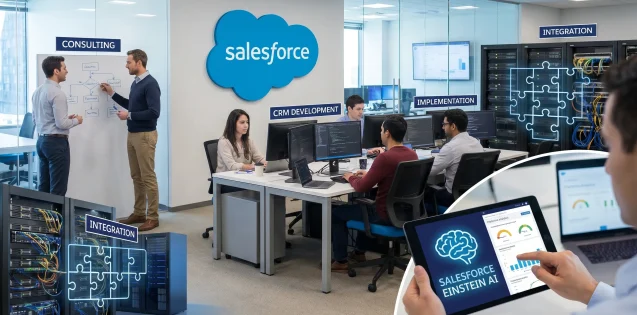
Salesforce Integration Solutions We Design, Build & Deploy

Proven integration solution patterns engineered for enterprise data complexity, operational reliability, and long-term governance.

create_image_related_to_or_202606161709
Salesforce–SAP Integration Platform

Bi-directional Salesforce and SAP S/4HANA or ECC integration - accounts, contacts, orders, invoices, pricing, and inventory synchronised with field mapping governance, conflict resolution, error handling, and audit trail architecture.
Salesforce–Oracle ERP Integration

Salesforce connected to Oracle ERP Cloud or E-Business Suite - customer master data, order management, billing, and financial reporting synchronised with transformation logic handling Oracle data model complexity.

Salesforce–Microsoft Dynamics Integration

Governed bi-directional data flow between Salesforce and Microsoft Dynamics 365 Finance or Supply Chain - for organisations operating both platforms requiring real-time synchronisation without manual re-entry or batch latency.

Salesforce–Workday HR Integration

Automated employee data synchronisation - 1 user provisioning, role assignment, territory updates, and organisational hierarchy alignment triggered by Workday hire, change, and termination events in real time.

MuleSoft API-Led Integration Architecture

Enterprise MuleSoft implementation replacing point-to-point sprawl - Experience, Process, and System API layers connecting Salesforce to ERP, HRMS, and third-party systems through a governed, reusable, monitored API estate.

Real-Time Event-Driven Integration Platform

Platform Events and Change Data Capture enabling real-time Salesforce-triggered downstream notifications - order confirmations to ERP, customer updates to fulfilment, and case events to operational platforms without polling or batch latency.

Legacy System Connectivity Programme

Middleware and adapter-based connectivity to legacy ERP, mainframe, and on-premises systems - extending CRM data reach to operational records without requiring legacy modernisation as a prerequisite.

Integration Estate Audit & Modernisation

Comprehensive audit of existing Salesforce integration landscape - undocumented connections catalogued, failure points identified, security gaps assessed - followed by phased modernisation replacing brittle integrations with governed, observable architecture.
Our Delivery Process for Salesforce Integration Engagements

Six stages from integration landscape discovery to governed production connectivity and ongoing estate management.

Integration Discovery & Landscape Assessment

Current estate audit · source and target system mapping · data model alignment analysis · API availability assessment · synchronisation frequency and volume requirements · use cases prioritised by operational impact, data criticality, and technical complexity

Integration Architecture & Governance Design

Middleware platform selection · API-led connectivity design · data transformation strategy · error handling and retry architecture · authentication and security framework · monitoring and alerting design · blueprint approved before build

Environment Setup & Integration Foundation

MuleSoft Anypoint Platform configuration · Connected App and Named Credential setup · authentication framework implementation · development and staging environment provisioning · error logging and dead-letter queue configuration — established before first integration build

Integration Development & Transformation Build

API and Mule application development in governed sprints · DataWeave transformation logic · field mapping and conflict resolution · bulk processing and batch job development · Platform Events and Change Data Capture configuration · iterative testing against data accuracy and performance thresholds throughout

QA, Data Validation & Security Review

End-to-end integration testing across all systems · data transformation accuracy validation · volume and performance testing under load · security review covering authentication, encryption, and PII handling · structured UAT with business, IT, and compliance stakeholders · production approval gate

Production Deployment, Monitoring & Managed Services

Managed production release · Anypoint Monitoring and alerting configuration · operational runbook delivery · IT and admin handover · hypercare support · ongoing managed services covering monitoring, incident management, version governance, and estate expansion

Why Enterprises Choose Us As Their Salesforce Integration Partner

The difference between an API development vendor and a Salesforce integration engineering partner is accountability – for data integrity, system reliability, and operational continuity.

  • Integration architecture designed before development begins – middleware selection, API-led connectivity, error handling strategy, and security framework established upfront, not discovered during build.
  • Every integration built for production resilience – retry logic, dead-letter queues, payload validation, rate limit management, and monitoring from day one, not added after the first production failure.
  • MuleSoft expertise delivering governed API estates – not point-to-point connections that solve immediate requirements while accumulating undocumented, unmonitored integration debt at scale.
  • Data integrity as a first-order requirement – field mapping governance, conflict resolution logic, and audit trail architecture ensuring integration does not degrade the Salesforce data quality CRM value depends on.
  • Compliance and security built into the integration layer – OAuth, JWT, Named Credentials, payload encryption, PII masking, and data residency compliance for regulated industries where every system boundary is an audit scope item.
  • End-to-end ownership across architecture, development, testing, monitoring, documentation, and managed services – one accountable partner from discovery through ongoing production estate governance.
Don't Worry!

Our expert will solve your queries in one call.

Client Triumphs: Success Stories

Discover how our team of domain specialists have addressed industry-specific challenges and mission-critical needs. Turning your Vision into Victory, One Success Story at a time!

FAQs on Salesforce Integration Services

Have a question? We’re here to help.

When should an enterprise use MuleSoft versus direct REST API integration?

Direct REST or SOAP API integration suits single, stable, low-complexity connections where the requirement is bounded and unlikely to expand. MuleSoft is the right architecture when the landscape involves multiple systems, reusable data assets shared across flows, enterprise API governance requirements, or an expanding connectivity roadmap – MuleSoft’s API-led architecture reduces future integration cost through reuse and gives IT the monitoring and change management capability point-to-point connections cannot provide at scale.

How do you ensure integrations don't degrade Salesforce data quality?

Data quality is an architecture decision, not a post-deployment task. We define field mapping governance, transformation rules, conflict resolution logic (determining source of truth per data domain), and validation frameworks before development begins. Duplicate detection is configured at integration boundaries, and every integration validates payloads before writing to Salesforce. Post-go-live data quality monitoring is included in production governance.

How do you handle integration failures and production incidents?

Every integration includes dead-letter queue management capturing failed messages for replay, structured error logging for root-cause visibility, automated alerting on failure thresholds, and retry logic with exponential backoff for transient failures. Operational runbooks documenting failure scenarios and resolution procedures are delivered at go-live. Managed services include defined incident response SLAs, proactive monitoring, and regular health reviews.

How long does a Salesforce ERP integration take?

A focused Salesforce-to-ERP integration covering a defined object set — accounts, orders, invoices — completes in 6–10 weeks for standard ERP platforms with accessible APIs. Complex integrations involving legacy ERP, high object volume, multi-entity data models, or MuleSoft platform implementation alongside delivery are phased across 3–5 months, governed by source system API maturity and data model complexity.

Can you integrate Salesforce with legacy systems that don't have modern APIs?

Yes — where modern APIs are unavailable, we implement middleware-based adapters, FTP/SFTP file pipelines, message queue integration via IBM MQ or Azure Service Bus, and database-level connectivity via secure JDBC or ODBC. The integration architecture abstracts legacy system limitations from Salesforce — the CRM operates against governed APIs regardless of what the downstream system exposes.

How do you manage integration security for regulated industries?

Compliance requirements are captured during discovery and embedded as design constraints throughout solution architecture. For regulated industries, we configure Salesforce Shield – Platform Encryption, Event Monitoring, and Field Audit Trail – data residency settings, consent management frameworks, and role-based access controls before any data is migrated. We have delivered compliant Salesforce implementations under FCA, HIPAA, MiFID II, GDPR, NERC CIP, and FedRAMP frameworks.
What does an integration estate audit involve and when is one needed?

An integration estate audit catalogues every Salesforce integration connection – documented and undocumented — covering data flow mapping, API version currency, authentication method, error handling maturity, monitoring coverage, and business criticality. Organisations need one when integrations have accumulated across multiple implementations without centralised governance, following an acquisition, when production incidents are increasing, or when a new system implementation requires understanding the full dependency landscape before change. The output is a prioritised modernisation roadmap with risk and effort quantified per integration.


Still Have Questions?

Can’t find the answer you’re looking for? Please get in touch with our team.

We Empower 170+ Global Businesses

Mars Logo
Johnson Logo
Kimberly Clark Logo
Coca Cola Logo
loreal logo
Jabil Logo
Hitachi Energy Logo
SkyWest Logo

Let’s innovate together!

Engage with a premier team renowned for transformative solutions and trusted by multiple Fortune 100 companies. Our domain knowledge and strategic partnerships have propelled global businesses.
Let’s collaborate, innovate and make technology work for you!

Our Locations

101 E Park Blvd, Plano,
TX 75074, USA

1304 Westport, Sindhu Bhavan Marg,
Thaltej, Ahmedabad, Gujarat 380059, INDIA

Phone Number

+1 817 380 5522


    Loading...

    Area Of Interest *

    Explore Our Service Offerings

    Hire A Team / Developer

    Become A Technology Partner

    Job Seeker

    Other