













What Kernshell Builds: QA Automation Services for Enterprise

Transform software quality and release operations with QA automation solutions engineered for speed, reliability, scalability, and continuous delivery.

We design QA automation frameworks aligned to development workflows, release governance, compliance standards, and enterprise scalability goals – enabling organizations to deliver high-quality software with greater speed and operational confidence.

Our QA Automation Capabilities Include:

  • Automated Functional & Regression Testing improving release quality and delivery efficiency
  • API & Integration Testing ensuring reliable connectivity across enterprise systems and platforms
  • Performance & Load Testing validating scalability, stability, and operational resilience
  • CI/CD Test Automation supporting continuous integration and continuous deployment pipelines
  • Cross-Platform Test Automation for web, mobile, SaaS, and enterprise application ecosystems
  • QA Governance & Reporting providing centralized visibility, test coverage, and release insights

From automation strategy and framework development to optimization and continuous testing operations, Kernshell helps enterprises operationalize QA automation ecosystems that improve software reliability, accelerate releases, and strengthen enterprise-wide digital delivery performance.

End-to-End QA Automation Services We Offer

QA Strategy & Test Architecture Design

Test strategy and automation planning covering coverage assessment, risk-based prioritisation, framework selection, testing architecture, CI/CD integration, and quality gates – designed to improve release confidence, minimise maintenance overhead, and support scalable, sustainable quality engineering.

Test Automation Framework Build

Test automation framework implementation covering architecture, configuration, test data management, environment strategy, reporting, failure diagnostics, parallel execution, and CI/CD integration – aligned with engineering standards, code ownership, and development workflows to ensure long-term maintainability and team adoption.

Functional UI & End-to-End Test Automation

End-to-end test automation for critical user journeys, workflows, and regression coverage using Playwright, Cypress, Selenium, or WebdriverIO. Includes maintainable test architecture, data-driven design, environment-aware execution, and proactive flakiness management to ensure reliable, trusted automation across delivery pipelines.

API & Integration Contract Testing

API test automation covering functional validation, schema compliance, authentication, authorisation, error handling, edge cases, and contract verification using REST Assured, Supertest, Karate, or Postman/Newman. Includes CI-integrated consumer-driven contract testing to detect breaking changes before they impact dependent services.

Component & Unit Test Coverage

Unit and component testing services including coverage assessment, gap analysis, risk-based coverage improvement, and CI quality gate implementation. Coverage investment is prioritised around business-critical logic, edge cases, and defect risk, with automated governance to prevent coverage regression and maintain code quality.

Performance & Load Testing

Performance testing services covering strategy, load modelling, scenario design, execution, bottleneck analysis, and CI-integrated regression testing using k6, Gatling, JMeter, or Locust. Includes baseline benchmarking, SLA validation, capacity planning, load, stress, spike, and soak testing to identify performance risks before production impact.

Security Test Automation

Shift-left security testing aligned with OWASP Top 10, including SAST, DAST, dependency vulnerability scanning, and secrets detection integrated into CI/CD pipelines. Automated security controls identify risks early, support continuous remediation, and reduce the cost, exposure, and operational impact of post-release vulnerabilities.

Visual Regression Testing

Visual regression testing with Chromatic, Percy, or Playwright, establishing approved UI baselines and detecting unintended visual changes before release. Integrated into pull request workflows, ensuring visual consistency, design system integrity, and brand quality without relying solely on functional testing.

Accessibility Test Automation

Automated accessibility testing integrated into CI/CD using axe-core, Playwright, and Lighthouse, with WCAG 2.1/2.2 validation across components, pages, and user journeys. Accessibility regressions are detected early and blocked from release, supporting continuous compliance and reducing remediation risk.

Test Observability, Reporting & Analytics

Quality engineering reporting and analytics through Allure, TestRail, Xray, or custom dashboards – providing visibility into test results, coverage, flakiness, execution trends, defect escape rates, and release readiness. Actionable quality metrics support data-driven sprint reviews, risk assessment, and release decisions.

Our Core QA Automation Technology Stack

Frameworks, tooling, and CI infrastructure selected based on your application stack, team capability, and quality programme maturity – not tool certifications.

  • All
  • Languages
  • Gen AI platforms
  • Frameworks
  • Debugging & Tracing
  • Vector Databases
  • DBMS
  • Data Visualization

Languages

C#

C#

Rust

Rust

Python

Python

JavaScript

JavaScript

Java

Java

R

R

Gen AI platforms

LangChain

LangChain

Hugging Face

Hugging Face

Apache Spark

Apache Spark

Gemini

Gemini

Phi

Phi

Frameworks

LangChain

LangChain

LlamaIndex

LlamaIndex

PyTorch

PyTorch

Kedro

Kedro

TensorFlow

TensorFlow

Keras

Keras

Debugging & Tracing

Langsmith

Langsmith

Langfuse

Langfuse

Vector Databases

PostgreSQL

PostgreSQL

Chroma

Chroma

Milvus

Milvus

Qdrant

Qdrant

Pinecone

Pinecone

DBMS

PostgreSQL

PostgreSQL

MySQL

MySQL

MongoDB

MongoDB

CouchDB

CouchDB

Cassandra

Cassandra

Neo4j

Neo4j

Data Visualization

Power BI

Power BI

Tableau

Tableau

Languages

C#

C#

Rust

Rust

Python

Python

JavaScript

JavaScript

Java

Java

R

R

Gen AI platforms

LangChain

LangChain

Hugging Face

Hugging Face

Apache Spark

Apache Spark

Gemini

Gemini

Phi

Phi

Frameworks

LangChain

LangChain

LlamaIndex

LlamaIndex

PyTorch

PyTorch

Kedro

Kedro

TensorFlow

TensorFlow

Keras

Keras

Debugging & Tracing

Langsmith

Langsmith

Langfuse

Langfuse

Vector Databases

PostgreSQL

PostgreSQL

Chroma

Chroma

Milvus

Milvus

Qdrant

Qdrant

Pinecone

Pinecone

DBMS

PostgreSQL

PostgreSQL

MySQL

MySQL

MongoDB

MongoDB

CouchDB

CouchDB

Cassandra

Cassandra

Neo4j

Neo4j

Data Visualization

Power BI

Power BI

Tableau

Tableau

Ready to Build QA Automation That Enables Confident Releases?

Image
Image

Where QA Automation Delivers Enterprise-Grade Impact Across Functions

QA Automation Solutions We Can Design, Build & Integrate

Proven QA automation solution patterns – purpose-engineered for enterprise engineering programmes, regulated industry requirements, and production stability at scale.

Create_a_premium_enterprise-grade_website_202606161331 (1)
Shift-Left Quality Engineering Programme

Shift-left quality engineering embedded in development workflows, including unit testing standards, TDD coaching, API contract testing, PR-level quality gates, and developer feedback loops - reducing defect costs by identifying quality issues at the earliest stage of delivery.

Enterprise Test Automation Programme

End-to-end QA automation programme covering strategy, framework development, functional and API testing, CI/CD integration, reporting, and governance - replacing manual testing with scalable quality engineering measured by defect escape rate and regression cycle time.

CI/CD Quality Gate Architecture

CI/CD quality gates covering unit, integration, API contract, security, accessibility, performance, and visual regression testing - with automated failure routing, notifications, and governance. Release decisions are driven by objective quality evidence, not manual sign-offs.

Performance Engineering Programme

Performance engineering covering load modelling, baseline benchmarking, SLA definition, regression detection, capacity planning, and bottleneck analysis - validating application performance across real-world workloads, data volumes, and concurrency before production release.

API Contract Testing Platform

Consumer-driven contract testing with Pact, enabling versioned API contracts, CI verification, and early detection of breaking changes across service boundaries - maintaining integration reliability in microservices and distributed architectures.

Security Test Automation Programme

Continuous security automation with SAST, DAST, dependency scanning, and secrets detection embedded in CI/CD - identifying and remediating vulnerabilities during development to prevent security debt and maintain an ongoing security posture.

QA Automation Rescue & Remediation

QA automation recovery and optimisation, including flaky test analysis, framework assessment, test stabilisation, CI reliability improvements, and team enablement - transforming slow, unreliable automation suites into trusted, maintainable quality infrastructure.

Mobile Test Automation Platform

Cross-platform mobile test automation using Appium, WebdriverIO, and Maestro, integrated with device farms and CI/CD pipelines - validating critical user journeys across real iOS and Android devices to detect platform-specific defects before release.

Our Process For QA Automation Delivery

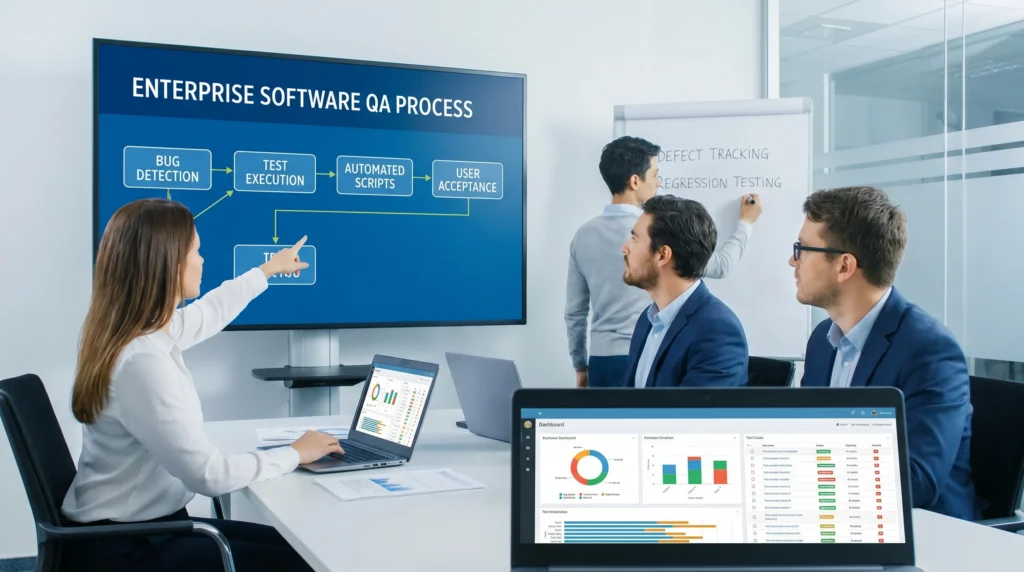
A six-stage delivery process – from quality assessment and strategy through governed, CI-integrated, and team-owned production automation.

QA Assessment & Strategy

Current testing maturity assessment · application architecture analysis · defect escape rate baseline · manual testing effort analysis · risk-based test prioritisation · framework selection · CI/CD integration strategy · quality gate definition → test automation strategy and delivery roadmap approved before framework build begins.

Framework Architecture & Environment Setup

Framework design · project structure · configuration management · test data strategy · environment management · reporting integration · parallel execution architecture · CI pipeline skeleton → architecture reviewed by engineering, QA, and DevOps stakeholders before test development commences.

Test Suite Development & CI Integration

Automated test implementation across prioritised scope · page object model build · API test suite development · contract test implementation · unit coverage improvement · CI quality gate configuration · test reporting integration → tests executing in CI with quality gate enforcement from the first suite delivery.

Performance, Security & Specialist Testing

Performance test scenario design and execution · load baseline establishment · SAST and DAST integration · dependency scanning · visual regression baseline · accessibility automation · mobile test suite development → specialist test coverage integrated into CI pipeline alongside functional automation.

Reliability, Coverage & Team Enablement

Flakiness audit and remediation · coverage gap analysis · test data management refinement · CI pipeline optimisation for execution time · team training and test authoring enablement → test suite stable, coverage targets met, and engineering team owning and contributing to automation before handoff.

Ongoing Governance, Maintenance & Optimisation

Test suite health monitoring · flakiness trend tracking · coverage regression alerting · framework dependency updates · test gap identification as features ship · quarterly automation health review → quality programme compounding in coverage and reliability as the application and engineering team evolve.

Why Enterprises Choose Us As Their QA Automation Partner

The difference between a QA services provider and a QA automation partner is accountability – for defect escape rate, release confidence, and engineering team ownership, not test execution throughput.

  • Quality engineering focused on scalable automation frameworks that development teams can trust, maintain, and extend.
  • Architecture-led test automation with frameworks, CI/CD integration, and quality gates designed upfront.
  • Comprehensive testing coverage across unit, integration, API, end-to-end, performance, security, accessibility, and visual regression.
  • Strong focus on test reliability, with proactive flakiness management and continuous framework optimisation.
  • Experience supporting regulated environments with compliance-ready testing, audit evidence, and governance controls.
  • Outcome-driven programmes measured by reduced defect leakage, faster releases, and lower manual testing effort.
Don't Worry!

Our expert will solve your queries in one call.

Client Triumphs: Success Stories

Discover how our team of domain specialists have addressed industry-specific challenges and mission-critical needs. Turning your Vision into Victory, One Success Story at a time!

FAQs on QA Automation Services

Have a question? We’re here to help.

What is QA automation and what does Kernshell deliver?

QA automation replaces manual software testing with automated test suites integrated into CI/CD pipelines – validating application behaviour, API contracts, performance characteristics, security posture, and accessibility compliance on every code change without human test execution. Kernshell delivers end-to-end: test strategy, framework build, functional automation, API contract testing, performance engineering, security test integration, CI/CD quality gates, reporting, and ongoing governance – with accountability for defect escape rate, release confidence, and engineering team ownership of the automation programme.

Which test automation frameworks does Kernshell use?

Framework selection is driven by your application stack, team language preferences, browser and device requirements, and existing toolchain – not by framework certification. Playwright for modern web applications requiring reliable cross-browser execution. Cypress for teams prioritising developer experience in single-browser workflows. Appium for mobile. REST Assured, Supertest, or Karate for API testing. k6 or Gatling for performance. Pact for contract testing. Every framework decision is justified against your specific requirements – not defaulted to the tool the team most recently certified in.

What is the difference between QA automation and manual testing - and when does Kernshell recommend each?

Automated testing executes predefined test scenarios consistently, at speed, on every code change – it is the right investment for regression coverage, API contract verification, performance baselines, and scenarios where consistency and repeatability generate more value than human judgement. Manual testing applies human cognition to exploratory scenarios, edge cases, usability evaluation, and new feature validation where the test conditions are not yet defined precisely enough to automate reliably. Kernshell recommends a test strategy that allocates automated coverage to the scenarios where automation compounds value and preserves manual testing capacity for the scenarios where human judgement is irreplaceable.

How does Kernshell integrate QA automation into our existing CI/CD pipeline?

Test automation is integrated into your existing CI/CD toolchain – GitHub Actions, GitLab CI, Azure DevOps, Jenkins, or CircleCI – with quality gates configured at the commit, pull request, and deployment stages appropriate to each test type. Unit and component tests on every commit. API and integration tests on every pull request. End-to-end functional tests on deployment to staging. Performance regression tests on every significant build. Security and dependency scans on every build. Test results published to your reporting platform with failure notification routing configured to the responsible engineering team – not to a centralised QA queue that creates a handoff bottleneck.

How does Kernshell handle flaky tests in automation suites?

Flakiness is treated as a defect in the test programme with the same severity as a production defect – not as an acceptable property of test automation that engineering teams work around by re-running failing pipelines. Kernshell’s flakiness remediation process: automated flakiness detection through test result trend analysis, root cause classification (environment dependency, timing, test data, selector fragility, test isolation failure), targeted remediation addressing the root cause rather than adding retry logic that masks the underlying failure, and framework design decisions that prevent the most common flakiness causes from the first test suite implementation.

How long does a QA automation programme take with Kernshell?

A focused framework build and initial test suite – covering critical user journeys, API contracts, and CI integration – reaches production in 8–12 weeks. Enterprise QA automation programmes spanning functional automation, performance testing, security integration, mobile testing, and visual regression are scoped with milestones following the quality assessment – typically 14–24 weeks depending on application complexity, CI pipeline maturity, and test coverage scope. Ongoing expansion of coverage and framework capability continues beyond initial delivery as the application evolves.

Does Kernshell provide QA automation for regulated industries requiring validation evidence?

Yes – pharmaceutical, medical device, financial services, and regulated technology environments are active verticals. For CSV-regulated applications, Kernshell designs test automation to produce the execution evidence, traceability artefacts, and test summary reports required for IQ/OQ/PQ validation documentation. For SOX IT controls, automated test execution logs and quality gate results are structured for audit evidence. For accessibility-regulated environments, axe-core CI integration produces the automated test execution records required for WCAG compliance documentation. Regulatory requirements are mapped to test automation design from the first strategy session – not added as documentation overhead after the automation programme is built.

Still Have Questions?

Can’t find the answer you’re looking for? Please get in touch with our team.

We Empower 170+ Global Businesses

Mars Logo
Johnson Logo
Kimberly Clark Logo
Coca Cola Logo
loreal logo
Jabil Logo
Hitachi Energy Logo
SkyWest Logo

Let’s innovate together!

Engage with a premier team renowned for transformative solutions and trusted by multiple Fortune 100 companies. Our domain knowledge and strategic partnerships have propelled global businesses.
Let’s collaborate, innovate and make technology work for you!

Our Locations

101 E Park Blvd, Plano,
TX 75074, USA

1304 Westport, Sindhu Bhavan Marg,
Thaltej, Ahmedabad, Gujarat 380059, INDIA

Phone Number

+1 817 380 5522


    Loading...

    Area Of Interest *

    Explore Our Service Offerings

    Hire A Team / Developer

    Become A Technology Partner

    Job Seeker

    Other