













- Services
-
-
- Service Platform
Artificial Intelligent
AI, ML & Data Engineering
End-to-end digital services spanning AI, data, development, cloud, and design.
ETQ Reliance
Enterprise Platforms
Migrate, manage, deploy, and optimize M365, Azure, Power Platform, and Microsoft Teams
Software Development
Mobile & Web
UI/UX Design
Software Testing & QA
Digital Engineering
End-to-end digital services spanning AI, data, development, cloud, and design.
Cloud Infrastructure
DevOps & Automation
Cloud
Migrate, manage, deploy, and optimize M365, Azure, Power Platform, and Microsoft Teams
Security Engineering
Risk & Compliance
Cybersecurity
Security engineering, compliance, and risk management
-
-
- Industries & Customers
- Solutions
-
-
Solutions
End-to-end IT solutions to transform, manage, and scale your digital ecosystem.
-
-
- Insights
-
- Company
-
Enterprise Site Reliability Engineering Services Reliability Measured.
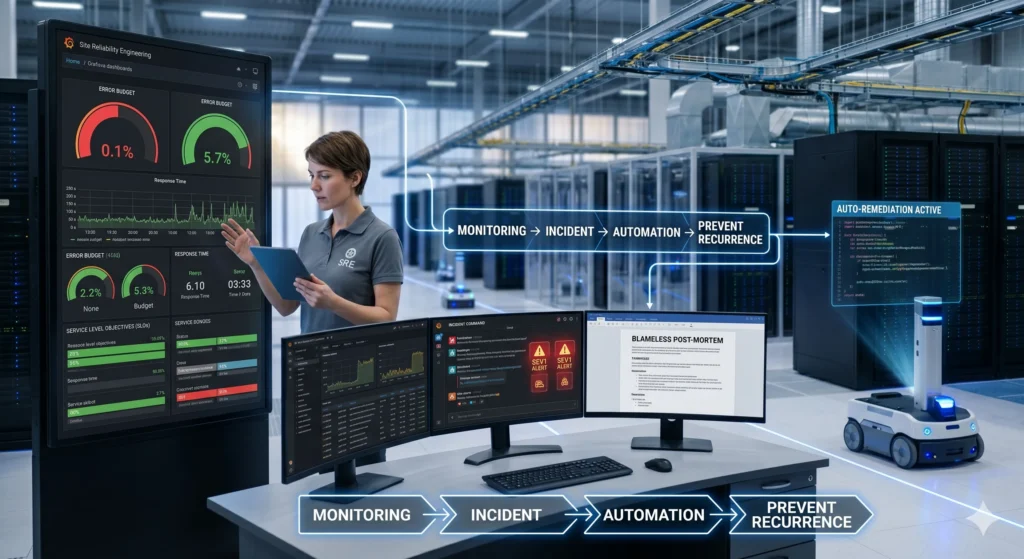
We implement, operate, and mature enterprise Site Reliability Engineering (SRE) programmes – including SLI/SLO frameworks, observability, incident management, chaos engineering, and automation. Improving reliability, reducing operational risk, and enabling measurable, continuous service performance improvement.
What Kernshell Builds: Site Reliability Engineering (SRE) Services for Enterprise
Transform enterprise operations with Site Reliability Engineering services engineered for scalability, resilience, performance, and operational continuity.
Our Site Reliability Engineering Capabilities Include:
- Reliability Engineering & Production Operations improving uptime, stability, and operational resilience
- Infrastructure Automation & DevSecOps reducing manual operations and accelerating incident response
- Observability & Monitoring Platforms providing real-time visibility into systems, applications, and infrastructure
- Incident Management & Root Cause Analysis minimizing downtime and improving operational recovery processes
- Kubernetes & Cloud Operations supporting scalable and resilient cloud-native environments
- Performance Optimization & Capacity Planning ensuring scalable, high-performing enterprise operations
From SRE strategy and operational architecture to automation and continuous optimization, Kernshell helps enterprises operationalize reliability engineering ecosystems that improve availability, scalability, and enterprise-wide digital operational performance.
End-to-End Site Reliability Engineering Services We Offer
SRE Strategy & Reliability Programme Design
SRE maturity assessments and roadmap design covering team structure, operating models, tooling, and organisational change. Reliability practices are aligned to platform complexity, engineering culture, and availability objectives for sustainable adoption.
SLI, SLO & Error Budget Framework
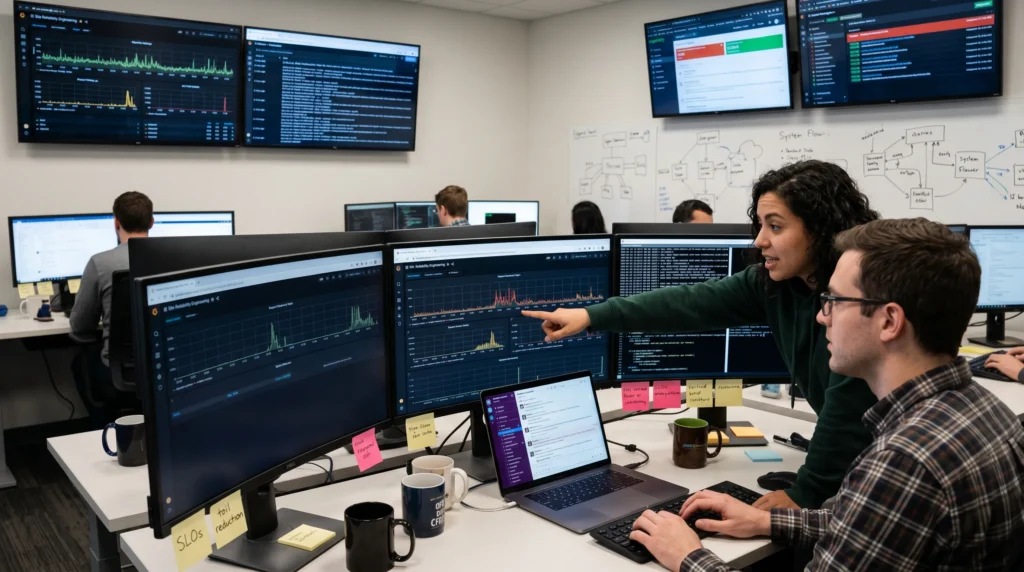
SLI and SLO frameworks for availability, latency, throughput, errors, and durability, with error budget policies and dashboards. Reliability targets are aligned to user and business outcomes, providing shared visibility across engineering and leadership teams.
Observability Engineering - Metrics, Logs & Traces
Observability platforms with metrics, logs, tracing, and OpenTelemetry instrumentation across applications and infrastructure. Delivers rapid root-cause analysis, reducing incident investigation time and improving operational visibility and reliability.
Alerting Framework & On-Call Engineering
SLO-based alerting with burn-rate policies, noise reduction, and early risk detection. Includes on-call design, escalation workflows, runbooks, and PagerDuty or Opsgenie integration to improve response effectiveness and reduce alert fatigue.
Incident Management & Post-Incident Review
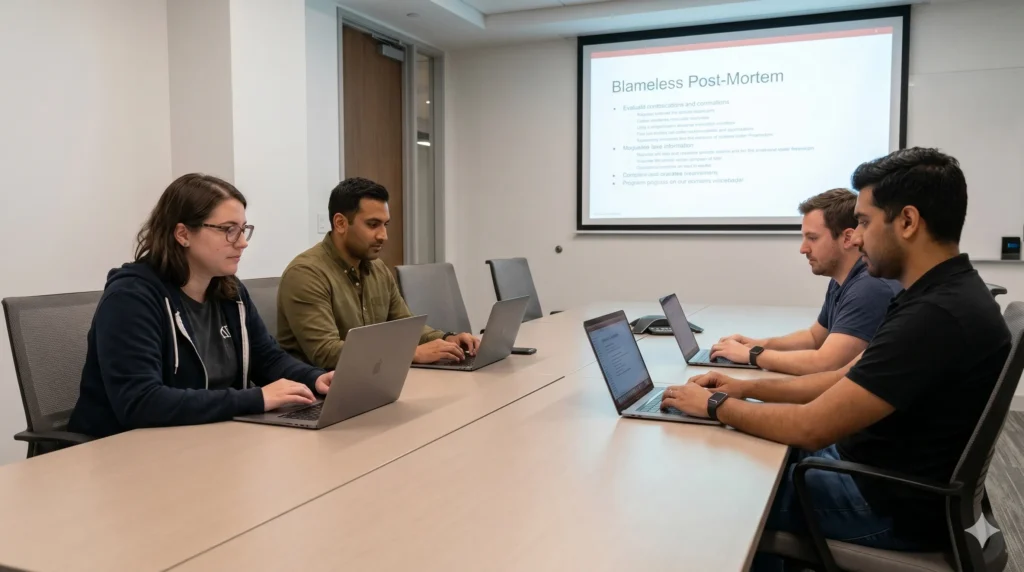
Incident management frameworks with severity models, incident command, communications, stakeholder updates, and resolution workflows. Blameless reviews, root-cause analysis, and action tracking turn incidents into measurable reliability improvements.
Toil Measurement & Elimination Programme
Toil assessments identify repetitive operational work and prioritise automation by impact and feasibility. Runbook automation, self-healing systems, and self-service capabilities reduce operational overhead, freeing engineers to focus on higher-value work.
Chaos Engineering & Resilience Validation
Chaos engineering programmes use controlled failure testing to validate failover, redundancy, retries, circuit breakers, and recovery mechanisms. Identifies resilience gaps early, ensuring systems behave as expected under real-world failure conditions.
Reliability Platform Engineering & Developer Self-Service
Internal developer platforms with self-service deployments, environment provisioning, service catalogues, golden paths, and reliability guardrails. Enables faster delivery, reduces platform team toil, and improves consistency, governance, and service reliability.
Capacity Planning & Traffic Management
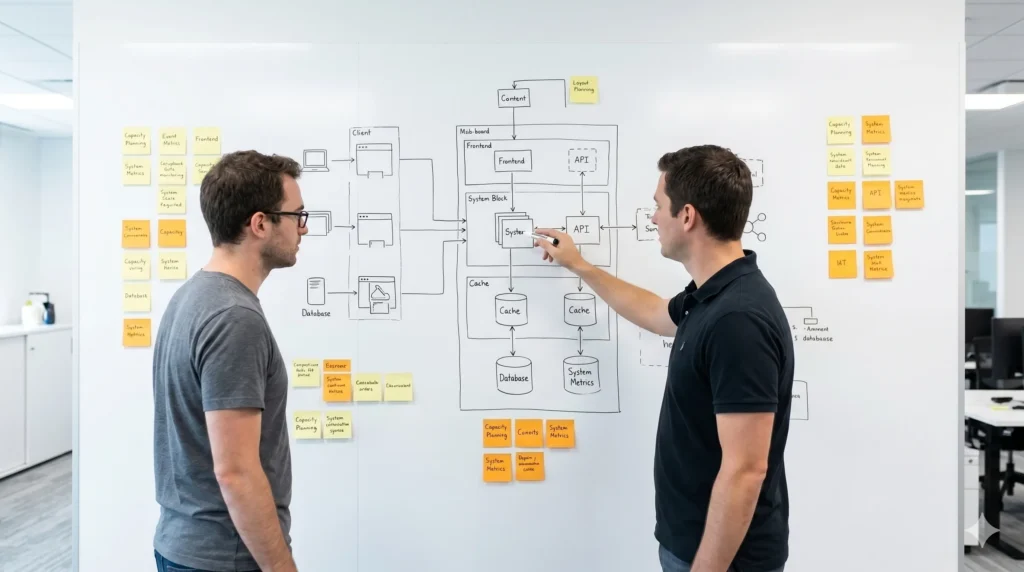
Capacity engineering with demand forecasting, capacity modelling, auto-scaling validation, and traffic management controls. Aligns infrastructure cost with demand while reducing the risk of over-provisioning, under-provisioning, and service instability.
SRE Tooling Implementation & Integration
Observability, incident management, status page, SLO, and CI/CD reliability tooling integrated into operational workflows. Platforms are configured, connected, and adopted with governance, ensuring measurable reliability outcomes rather than unused tooling.
Our Core SRE Technology Stack
Observability platforms, reliability tooling, and incident management infrastructure selected on your cloud architecture, compliance obligations, and operational maturity.
- All
- Languages
- Gen AI platforms
- Frameworks
- Debugging & Tracing
- Vector Databases
- DBMS
- Data Visualization
Languages
C#
Rust
Python
JavaScript
Java
R
Gen AI platforms
LangChain
Hugging Face
Apache Spark
Gemini
Phi
Frameworks
LangChain
LlamaIndex
PyTorch
Kedro
TensorFlow
Keras
Debugging & Tracing
Langsmith
Langfuse
Vector Databases
PostgreSQL
Chroma
Milvus
Qdrant
Pinecone
DBMS
PostgreSQL
MySQL
MongoDB
CouchDB
Cassandra
Neo4j
Data Visualization
Power BI
Tableau

Languages
C#
Rust
Python
JavaScript
Java
R
Gen AI platforms
LangChain
Hugging Face
Apache Spark
Gemini
Phi
Frameworks
LangChain
LlamaIndex
PyTorch
Kedro
TensorFlow
Keras
Debugging & Tracing
Langsmith
Langfuse
Vector Databases
PostgreSQL
Chroma
Milvus
Qdrant
Pinecone
DBMS
PostgreSQL
MySQL
MongoDB
CouchDB
Cassandra
Neo4j
Data Visualization
Power BI
Tableau

Where Site Reliability Engineering Delivers Enterprise-Grade Impact
Engineering & Platform Teams
Product & Commercial
Finance & Business Operations
Customer Experience
Legal & Compliance
Security & Risk
Sales & Partnerships
Executive Leadership
SRE Solutions We Design, Build & Deploy
Proven SRE solution patterns engineered for enterprise platform complexity, operational maturity, and sustained reliability improvement.
SRE Foundation Programme
End-to-end SRE implementation covering SLI/SLOs, observability, alerting, incident management, on-call operations, and reliability reviews. Establishes a measurable, proactive reliability practice that improves service performance and operational resilience.

Observability Platform Implementation
Full-stack observability with metrics, logs, tracing, and OpenTelemetry across applications and infrastructure. Grafana, Datadog, or similar platforms are integrated with SLO-driven dashboards, delivering actionable visibility and faster incident response.

SLO & Error Budget Programme
SLI and SLO workshops, error budget policies, burn-rate alerting, and reliability dashboards. Creates a measurable framework linking engineering decisions to user experience, with clear visibility into reliability performance and risk.
Incident Management Transformation
Incident management frameworks with severity models, incident command, communications, post-incident reviews, and improvement backlogs. Establishes a structured, learning-focused approach that reduces incident frequency and accelerates recovery.
Toil Elimination Programme
Toil assessments, automation roadmaps, runbook automation, self-healing systems, and self-service platforms reduce repetitive operational work. Frees engineering capacity for reliability improvements, innovation, and product development.
Chaos Engineering Programme
Chaos engineering programmes design and execute controlled failure tests to validate failover, redundancy, retries, and circuit breakers. Identifies resilience gaps early, ensuring systems perform as expected before real production failures occur.
Internal Developer Platform
Developer platforms with Backstage, service catalogues, golden path templates, self-service deployments, and reliability guardrails. Enables team autonomy while maintaining consistent operational standards, governance, and production reliability.
SRE Managed Advisory Retainer
Ongoing SRE advisory covering SLO reviews, error budgets, chaos engineering governance, observability optimisation, and reliability maturity assessments. Provides specialist expertise to sustain reliability improvements as systems and teams scale.
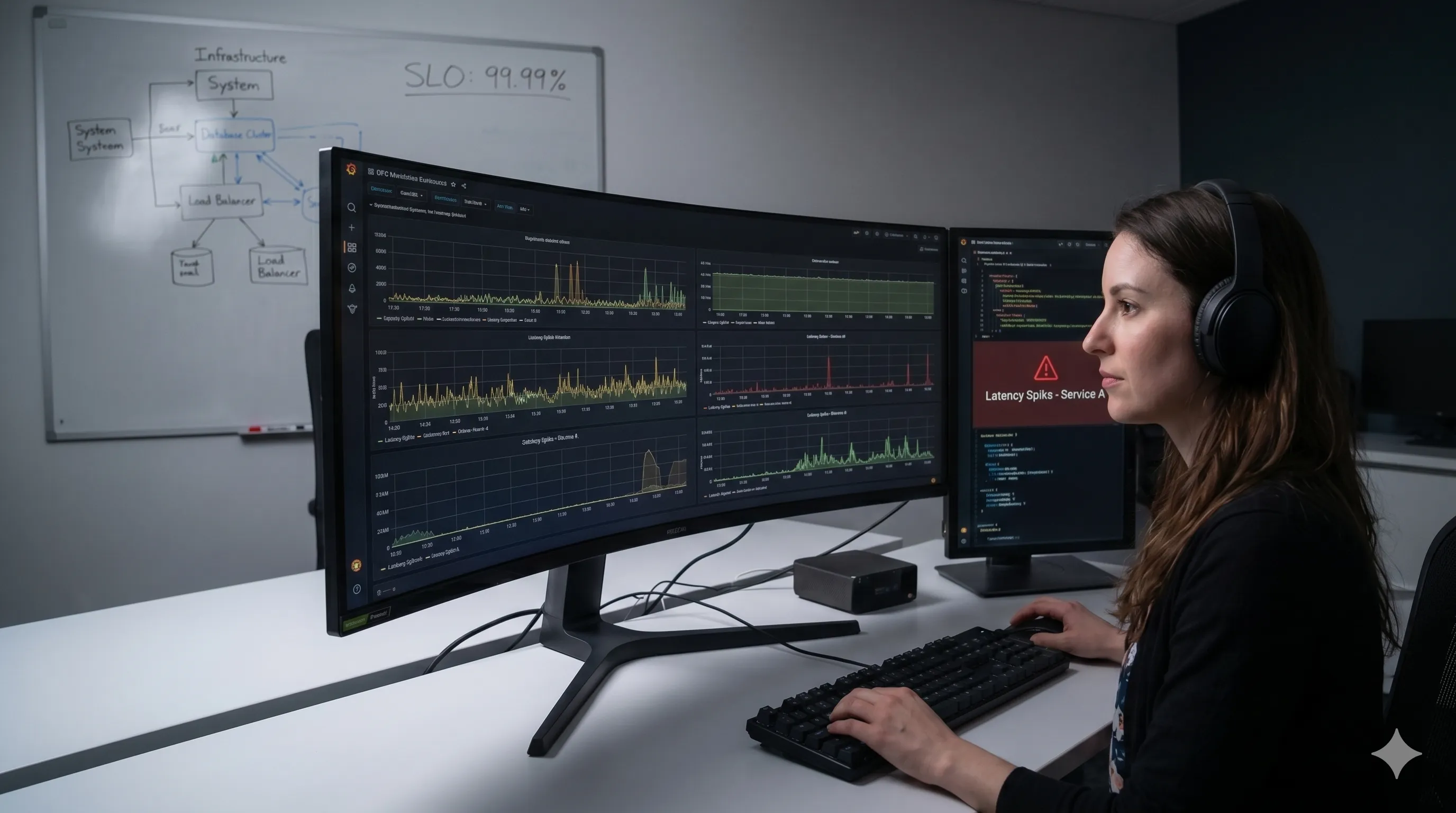
Our Delivery Process for SRE Engagements
Six stages from reliability assessment to governed SRE practice and ongoing reliability improvement.
SRE Maturity Assessment & Programme Design
CI/CD fragmentation audit · cognitive load assessment · infrastructure bottleneck analysis · DORA baseline measurement · golden path gap identification · IDP capability prioritisation · build-vs-buy evaluation → platform strategy and IDP roadmap approved before build begins.
SLI/SLO Framework & Reliability Baseline
Critical service identification · SLI definition per service (availability · latency · error rate · throughput) · SLO target setting grounded in user expectations · error budget policy design · reliability baseline measurement · SLO dashboard build · stakeholder alignment on reliability commitments and error budget governance before observability build begins
Observability Stack Implementation
Metrics platform deployment and configuration · log aggregation pipeline build · distributed tracing implementation · OpenTelemetry instrumentation across application and infrastructure layers · SLO-aligned dashboard creation · service dependency mapping · baseline performance characterisation · observability validated against incident diagnosis requirements before alerting redesign
Alerting Redesign, Incident Management & On-Call
SLO burn rate alert configuration · alert noise reduction and false positive elimination · incident severity classification framework · incident commander model implementation · communication template library · escalation policy configuration in PagerDuty or Opsgenie · runbook development · post-incident review process · on-call rotation design · simulation exercise validating process before live on-call adoption
Toil Elimination, Chaos Engineering & Platform Engineering
Toil automation roadmap execution · self-healing infrastructure implementation · chaos engineering programme initiation (hypothesis · blast radius · execution · remediation) · internal developer platform delivery · golden path template development · reliability guardrail configuration · resilience gap remediation validated through re-experimentation
SRE Capability Build & Ongoing Governance
SRE team enablement programme · SLO authoring workshops · incident management simulation exercises · chaos engineering training · reliability review cadence establishment · quarterly programme maturity review · error budget trend reporting · observability optimisation · ongoing advisory covering reliability risk, programme evolution, and tooling governance
Why Enterprises Choose Us As Their SRE Partner
The difference between an SRE tooling vendor and an enterprise SRE engineering partner is accountability – for reliability outcomes, engineering practice maturity, and the platform continuity your commercial commitments require.
- Reliability engineering built around user expectations and business impact through well-defined SLOs and error budgets.
- Observability-first approach with monitoring, dashboards, tracing, and alerting designed for rapid incident diagnosis.
- Intelligent alerting strategies that reduce noise, improve signal quality, and strengthen on-call effectiveness.
- Disciplined chaos engineering practices used to validate resilience, recovery processes, and system reliability.
- Proactive toil reduction through automation, operational optimisation, and continuous reliability improvement.
- End-to-end SRE expertise spanning observability, incident management, platform engineering, reliability governance, and operational excellence.
Our expert will solve your queries in one call.
Client Triumphs: Success Stories
Discover how our team of domain specialists have addressed industry-specific challenges and mission-critical needs. Turning your Vision into Victory, One Success Story at a time!
FAQs on Site Reliability Engineering Services
Have a question? We’re here to help.
Site Reliability Engineering (SRE) applies software engineering principles to infrastructure and operations, treating reliability as a measurable and continuously improving product feature. Unlike traditional operations, which often rely on manual processes and reactive support, SRE focuses on automation, reliability metrics, incident reduction, and scalable operational practices that improve system performance and resilience over time.
Service Level Indicators (SLIs) measure key aspects of service performance such as availability, latency, and error rates. Service Level Objectives (SLOs) define the target reliability levels for those metrics, while error budgets quantify the acceptable amount of service degradation within a given period. Together, they provide a structured framework for balancing product delivery speed with reliability, ensuring operational decisions are guided by measurable user experience outcomes.
An initial SRE foundation covering observability, SLI/SLO frameworks, alerting, and incident management can typically be established within 8–12 weeks. More comprehensive SRE programmes spanning multiple services, reliability automation, and operational maturity initiatives are usually delivered over several months, depending on organisational scale and complexity.
SLOs are defined based on user expectations, business impact, and service criticality. We use reliability data, user experience requirements, and stakeholder input to establish targets that balance operational resilience with delivery velocity. Where alignment is difficult, we facilitate structured workshops to reach agreement using measurable business and user outcomes rather than assumptions.
Chaos engineering is the practice of introducing controlled failures to verify system resilience and recovery capabilities. When supported by strong observability, defined safety controls, and clear rollback procedures, carefully designed experiments can be safely executed in production environments to validate reliability under real-world conditions.
We reduce alert fatigue by focusing on actionable alerts tied to service reliability and business impact. SLO-based alerting, alert tuning, and monitoring audits help eliminate unnecessary notifications while ensuring critical issues are detected early. The goal is to improve signal quality so engineering teams can respond effectively to meaningful incidents.
SRE complements DevOps and agile practices by embedding reliability into the software delivery lifecycle. Reliability objectives, observability requirements, incident learnings, and operational readiness checks are integrated into development workflows, CI/CD pipelines, and sprint planning. This ensures reliability becomes a shared responsibility rather than a separate operational function.


Still Have Questions?
Can’t find the answer you’re looking for? Please get in touch with our team.
Let’s innovate together!
Engage with a premier team renowned for transformative solutions and trusted by multiple Fortune 100 companies. Our domain knowledge and strategic partnerships have propelled global businesses.
Let’s collaborate, innovate and make technology work for you!
Our Locations
101 E Park Blvd, Plano, TX 75074, USA
1304 Westport, Sindhu Bhavan Marg, Thaltej, Ahmedabad, Gujarat 380059, INDIA
Email Address