













What Kernshell Delivers: Cybersecurity Risk Management for Enterprise

Protect your enterprise from financial loss, regulatory sanction, and operational disruption with cybersecurity risk management programmes engineered for quantified risk visibility, evidence-based treatment prioritisation, and continuous governance.

Cybersecurity Risk Management for Enterprise

Our Risk Management Capabilities Include:

  • Enterprise Cyber Risk Assessment using ISO 27005, NIST RMF, and FAIR methodologies
  • Threat Modelling and Attack Surface Analysis across application, infrastructure, and supply chain
  • Risk Quantification using FAIR and scenario-based financial exposure modelling
  • Risk Treatment Programme Design and delivery prioritised by exposure and commercial impact
  • Third-Party and Supply Chain Risk Management across complex vendor ecosystems
  • OT, ICS, and Critical Infrastructure Risk Assessment for industrial and energy environments
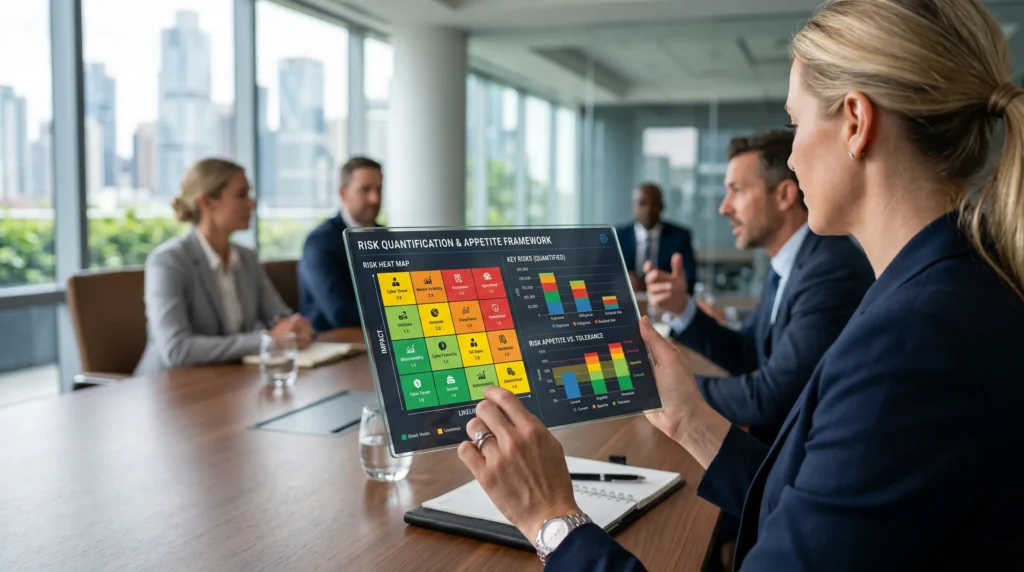
  • Board-Level Cyber Risk Reporting and risk appetite governance frameworks
  • Continuous Risk Monitoring through GRC platform implementation and automated posture management

From initial risk assessment and threat modelling through quantification, treatment delivery, and ongoing risk governance, Kernshell helps enterprises replace reactive, assumption-based cyber risk management with a continuous, evidence-driven discipline that reduces exposure and demonstrates governance accountability.

End-to-End Cybersecurity Risk Management Services We Offer

Enterprise Cyber Risk Assessment

Enterprise cyber risk assessments using ISO 27005, NIST RMF, or OCTAVE to identify assets, threats, and vulnerabilities, producing risk registers that prioritise treatment and guide security investment decisions.

FAIR Quantitative Risk Analysis

FAIR quantitative risk modelling translates cyber scenarios into financial loss exposure ranges, enabling boards and executives to prioritise security investments using evidence-based risk analysis rather than qualitative ratings.

Threat Modelling & Attack Surface Analysis

Threat modelling using STRIDE, PASTA, and MITRE ATT&CK to map attack paths, data flows, and entry points, identifying exploitable surfaces and providing architecture-specific, actionable threat intelligence.

Cyber Risk Appetite Framework

Risk appetite frameworks defining KRIs, thresholds, and governance structures that align cyber risk exposure across business units, enabling boards to make explicit, measurable risk acceptance decisions.

Risk Treatment Programme Design & Delivery

Risk treatment programmes structuring control selection, cost-benefit analysis, and remediation tracking, prioritising actions by risk reduction per investment unit to ensure measurable exposure reduction over compliance completeness.

Vulnerability Risk Management

Risk-based vulnerability management using CVSS/EPSS prioritisation, exploit intelligence, patch SLAs, exceptions, and trending to reduce actively exploitable vulnerabilities rather than volume-driven scan-and-patch cycles.

Third-Party & Supply Chain Risk Management

Third-party risk management with vendor tiering, assessments, questionnaires, contract controls, monitoring, and supply chain reporting to govern external attack surface and mitigate supply chain compromise risks.

OT, ICS & Critical Infrastructure Risk Assessment

OT/ICS risk assessments aligned to IEC 62443 covering SCADA/DCS assets, IT/OT convergence, network segmentation, and threat modelling for critical infrastructure where cyber risk impacts safety and operations.

Cyber Insurance Risk Quantification

Cyber insurance support using FAIR-based risk quantification, coverage gap analysis, and underwriting inputs to optimise policy limits and premiums based on financial loss exposure modelling.

Supported Frameworks

Our GRC practice is fluent across the world’s most critical regulatory and standards frameworks.

  • All
  • Languages
  • Gen AI platforms
  • Frameworks
  • Debugging & Tracing
  • Vector Databases
  • DBMS
  • Data Visualization

Languages

C#

C#

Rust

Rust

Python

Python

JavaScript

JavaScript

Java

Java

R

R

Gen AI platforms

LangChain

LangChain

Hugging Face

Hugging Face

Apache Spark

Apache Spark

Gemini

Gemini

Phi

Phi

Frameworks

LangChain

LangChain

LlamaIndex

LlamaIndex

PyTorch

PyTorch

Kedro

Kedro

TensorFlow

TensorFlow

Keras

Keras

Debugging & Tracing

Langsmith

Langsmith

Langfuse

Langfuse

Vector Databases

PostgreSQL

PostgreSQL

Chroma

Chroma

Milvus

Milvus

Qdrant

Qdrant

Pinecone

Pinecone

DBMS

PostgreSQL

PostgreSQL

MySQL

MySQL

MongoDB

MongoDB

CouchDB

CouchDB

Cassandra

Cassandra

Neo4j

Neo4j

Data Visualization

Power BI

Power BI

Tableau

Tableau

Languages

C#

C#

Rust

Rust

Python

Python

JavaScript

JavaScript

Java

Java

R

R

Gen AI platforms

LangChain

LangChain

Hugging Face

Hugging Face

Apache Spark

Apache Spark

Gemini

Gemini

Phi

Phi

Frameworks

LangChain

LangChain

LlamaIndex

LlamaIndex

PyTorch

PyTorch

Kedro

Kedro

TensorFlow

TensorFlow

Keras

Keras

Debugging & Tracing

Langsmith

Langsmith

Langfuse

Langfuse

Vector Databases

PostgreSQL

PostgreSQL

Chroma

Chroma

Milvus

Milvus

Qdrant

Qdrant

Pinecone

Pinecone

DBMS

PostgreSQL

PostgreSQL

MySQL

MySQL

MongoDB

MongoDB

CouchDB

CouchDB

Cassandra

Cassandra

Neo4j

Neo4j

Data Visualization

Power BI

Power BI

Tableau

Tableau

Ready to Move from Risk Registers to Quantified Cyber Risk?

Image
Image

Where Cybersecurity Risk Management Delivers Enterprise-Grade Impact Across Functions

Cybersecurity Risk Management Solutions We Can Design, Build & Deploy

Proven risk management solution patterns – purpose-engineered for the risk profiles, regulatory obligations, and governance standards of enterprise organisations.

Cybersecurity Risk Management Solutions
Enterprise Cyber Risk Assessment Programme

Enterprise risk assessment using ISO 27005 or NIST RMF covering assets, threats, vulnerabilities, and impact analysis, producing a prioritised risk register for treatment decisions and regulatory evidence.

FAIR Quantitative Risk Programme

FAIR-based cyber risk modelling quantifying financial loss exposure for scenarios like ransomware, data breach, and OT incidents, enabling board governance and insurance underwriting based on evidence-driven loss ranges.

Threat Modelling Programme

Systematic threat modelling using STRIDE and MITRE ATT&CK to map attack paths, identify architecture-specific threats, and prioritise security controls based on real adversary techniques rather than generic best practices.

Risk Treatment Implementation Programme

Risk treatment roadmap execution covering control selection, cost-benefit analysis, ownership, and effectiveness tracking, prioritising security investment toward highest material risk reduction rather than compliance coverage.

Third-Party Risk Management Programme

Third-party risk management with vendor tiering, assessments, questionnaires, contract clauses, monitoring, and supply chain dashboards to govern external attack surface at enterprise and regulatory scale.

OT & ICS Risk Assessment Programme

EC 62443-aligned OT risk assessments covering SCADA/DCS assets, IT/OT convergence, industrial threat modelling, and remediation roadmaps for critical infrastructure cyber-physical risk management.

GRC Risk Platform Implementation

GRC platform deployment enabling continuous risk management through automated risk registers, control monitoring, KRI dashboards, treatment tracking, and real-time reporting, replacing annual assessments with continuous governance visibility.

Board Cyber Risk Reporting Programme

Board risk dashboards and governance frameworks translating technical cyber risk into KRIs, risk appetite metrics, audit committee reporting, and regulatory disclosure for executive and regulatory decision-making.
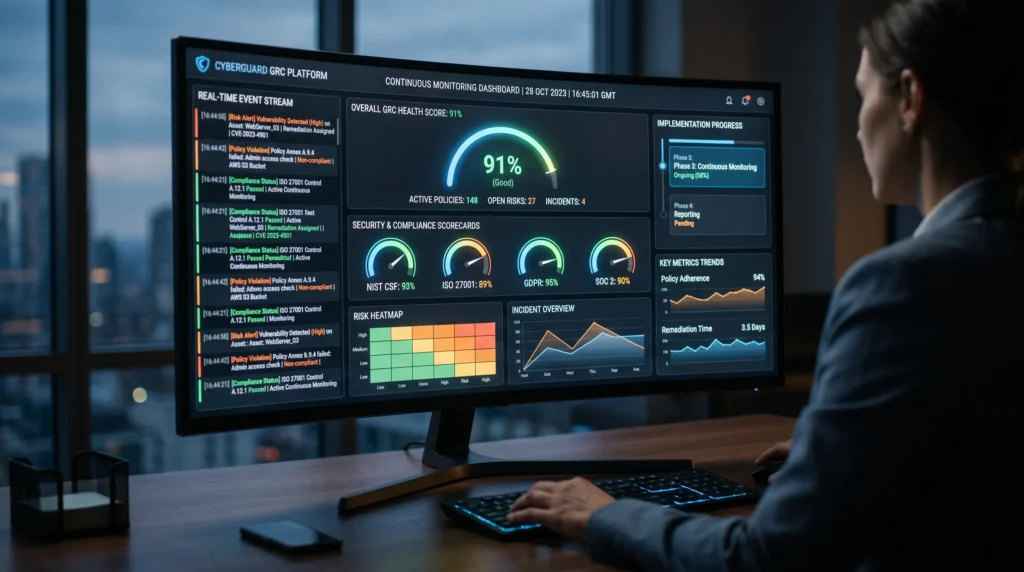
Our Process For Cybersecurity Risk Management Delivery

A six-stage process – from risk scope definition to continuous risk governance programme – with validated outputs at every stage.

Risk Scope Definition & Programme Design

Regulatory obligation mapping · risk assessment methodology selection · organisational scope and asset boundary definition · threat actor profiling · existing risk register and assessment review · stakeholder alignment on risk appetite and programme objectives · GRC platform requirements · programme roadmap approved by IT, legal, and executive stakeholders before assessment begins

Risk Scope Definition & Programme Design
Risk Assessment & Threat Modelling

Asset identification and classification · threat enumeration against asset inventory · vulnerability assessment (technical scanning and architectural review) · likelihood and impact analysis · FAIR scenario scoping for quantification · threat modelling across application and infrastructure scope · attack surface mapping · risk register development and initial prioritisation

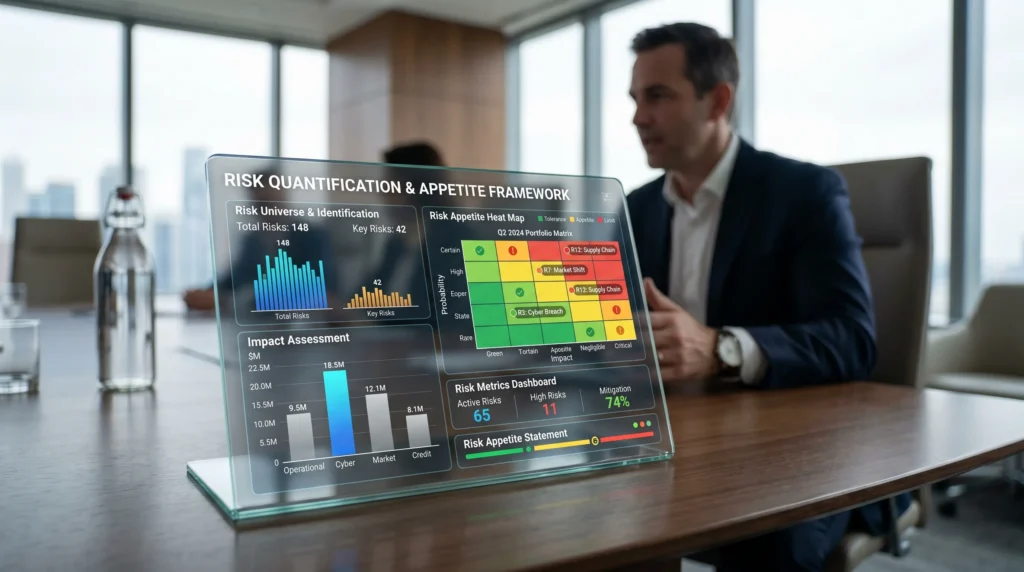
Risk Quantification & Appetite Framework

FAIR quantitative analysis for material risk scenarios · financial loss exposure range modelling · risk appetite statement development · KRI definition · risk tolerance threshold setting · insurance adequacy assessment · risk-adjusted investment prioritisation · quantification validated against business context before treatment programme design

Risk Quantification & Appetite Framework
Risk Treatment Programme Design & Delivery

Control selection against prioritised risk register · cost-benefit analysis per treatment option · treatment roadmap with ownership assignment · implementation project management · third-party risk assessment programme initiation · OT risk assessment execution where in scope · treatment effectiveness measurement framework · progress reporting against risk exposure reduction targets

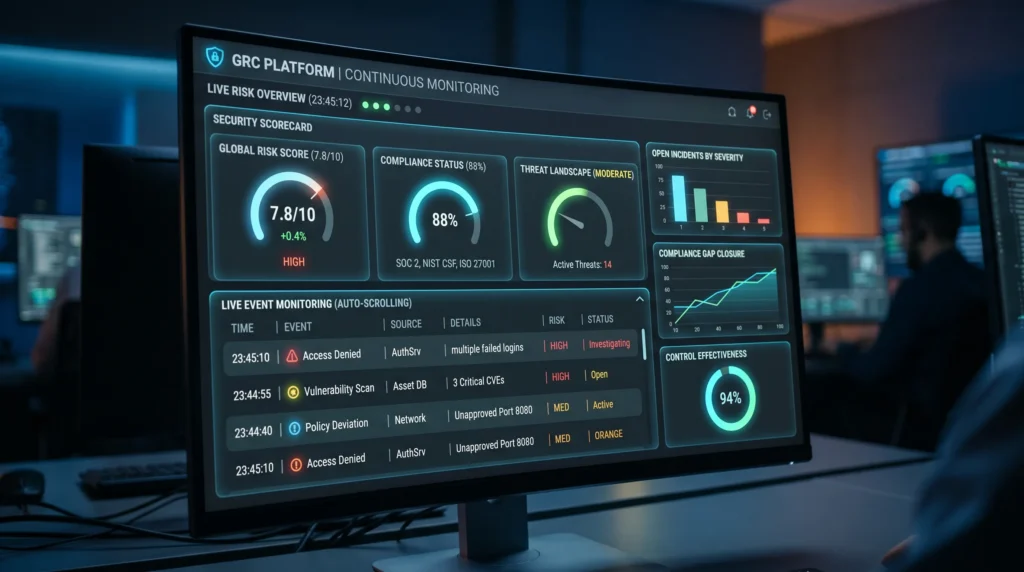
GRC Platform Implementation & Continuous Monitoring

GRC platform deployment and configuration · risk register migration · control monitoring automation · KRI dashboard build · treatment tracking workflow · board reporting template delivery · regulatory risk mapping · continuous monitoring validated against risk governance requirements before programme handover to internal ownership

GRC Platform Implementation & Continuous Monitoring
Ongoing Risk Governance & Programme Management

Quarterly risk assessment refresh · annual full risk assessment cycle · regulatory change monitoring · risk treatment programme progress review · board and audit committee reporting · third-party risk ongoing monitoring · GRC platform optimisation · risk programme maturity advancement planning · Virtual CISO advisory where applicable

Why Enterprises Choose Us As Their Compliance & Governance Partner

The difference between a risk assessment vendor and a risk management partner is accountability for exposure reduction, investment efficiency, and governance outcomes—not just risk reporting.

  • Enterprise risk programmes delivered to Fortune 500 standards across regulated industries including financial services, healthcare, manufacturing, energy, and technology.
  • Quantitative risk analysis using FAIR to translate cyber risk into financial loss exposure for board and insurance decision-making.
  • Risk-based investment prioritisation focused on reducing exposure per unit of spend, not just completing assessment checklists.
  • Threat intelligence–driven modelling aligned with MITRE ATT&CK and real-world adversary behaviour for accurate risk context.
  • OT and critical infrastructure risk expertise aligned with IEC 62443, covering safety-critical and industrial environments.
  • End-to-end ownership from risk assessment and quantification to treatment programmes, governance frameworks, and continuous risk management services.
Don't Worry!

Our expert will solve your queries in one call.

Client Triumphs: Success Stories

Discover how our team of domain specialists have addressed industry-specific challenges and mission-critical needs. Turning your Vision into Victory, One Success Story at a time!

Cybersecurity Risk Management FAQs

Have a question? We’re here to help.

What cybersecurity risk management services does Kernshell provide?

Kernshell delivers end-to-end risk management including enterprise risk assessments (ISO 27005, NIST RMF), FAIR quantitative risk analysis, threat modelling (STRIDE, MITRE ATT&CK), risk appetite and treatment design, vulnerability and third-party risk management, OT/ICS risk assessments, cyber insurance quantification, GRC implementation, and board-level cyber risk reporting.

What is FAIR and why is quantitative risk analysis more valuable than qualitative risk heat maps?

FAIR (Factor Analysis of Information Risk) quantifies cyber risk in financial terms instead of heat maps. It helps boards and CFOs make investment decisions based on expected financial loss (e.g., £ impact), enabling better prioritisation and ROI-driven security spending.

How does threat modelling differ from penetration testing and when does an enterprise need both?

Threat modelling is a design-time process that identifies risks before systems are built. Penetration testing is a validation-time process that finds real vulnerabilities in implemented systems. Both are required for complete security coverage.

How does Kernshell approach OT and ICS risk assessment differently from standard IT risk assessment?

OT/ICS risk includes physical safety, operational disruption, and environmental impact, not just data risk. It uses IEC 62443 and requires non-intrusive assessment methods due to industrial system sensitivity.

How do you integrate cyber risk management with enterprise risk management (ERM) frameworks?

Cyber risk is mapped into enterprise risk frameworks so it can be governed alongside financial and operational risks. This enables board-level oversight using consistent risk language and reporting.

How does Kernshell manage third-party cyber risk at the scale of a complex enterprise vendor ecosystem?

Vendor risk is tiered (high/medium/low) based on criticality. High-risk vendors get deep assessment and monitoring; others use lighter controls and automation tools. Fourth-party risk is also tracked through supply chain mapping.

How does Kernshell help organisations use cyber risk quantification to optimise their cyber insurance programme?

FAIR-based quantification provides real financial exposure data, helping organisations choose appropriate insurance coverage limits and improve underwriting outcomes based on actual risk rather than estimates.

Still Have Questions?

Can’t find the answer you’re looking for? Please get in touch with our team.

We Empower 170+ Global Businesses

Mars Logo
Johnson Logo
Kimberly Clark Logo
Coca Cola Logo
loreal logo
Jabil Logo
Hitachi Energy Logo
SkyWest Logo

Let’s innovate together!

Engage with a premier team renowned for transformative solutions and trusted by multiple Fortune 100 companies. Our domain knowledge and strategic partnerships have propelled global businesses.
Let’s collaborate, innovate and make technology work for you!

Our Locations

101 E Park Blvd, Plano,
TX 75074, USA

1304 Westport, Sindhu Bhavan Marg,
Thaltej, Ahmedabad, Gujarat 380059, INDIA

Phone Number

+1 817 380 5522


    Loading...

    Area Of Interest *

    Explore Our Service Offerings

    Hire A Team / Developer

    Become A Technology Partner

    Job Seeker

    Other