













What Kernshell Builds: MLOps Services for Enterprise

Transform AI initiatives into scalable, production-ready systems with enterprise MLOps solutions engineered for reliability, governance, and operational performance.

Our MLOps Capabilities Include:

  • End-to-End ML Pipeline Automation for scalable AI operations
  • CI/CD & Infrastructure Automation for machine learning deployment
  • Model Monitoring, Observability & Performance Management
  • LLMOps Frameworks for enterprise Generative AI governance
  • AI Infrastructure Orchestration across cloud and hybrid environments
  • Secure AI Governance with compliance, access control, and auditability

From architecture and automation to monitoring and continuous optimization, Kernshell helps enterprises operationalize AI and machine learning systems with production-grade reliability, scalability, and governance.

End-to-End MLOps & AI Operations Services We Offer

ML Pipeline Automation

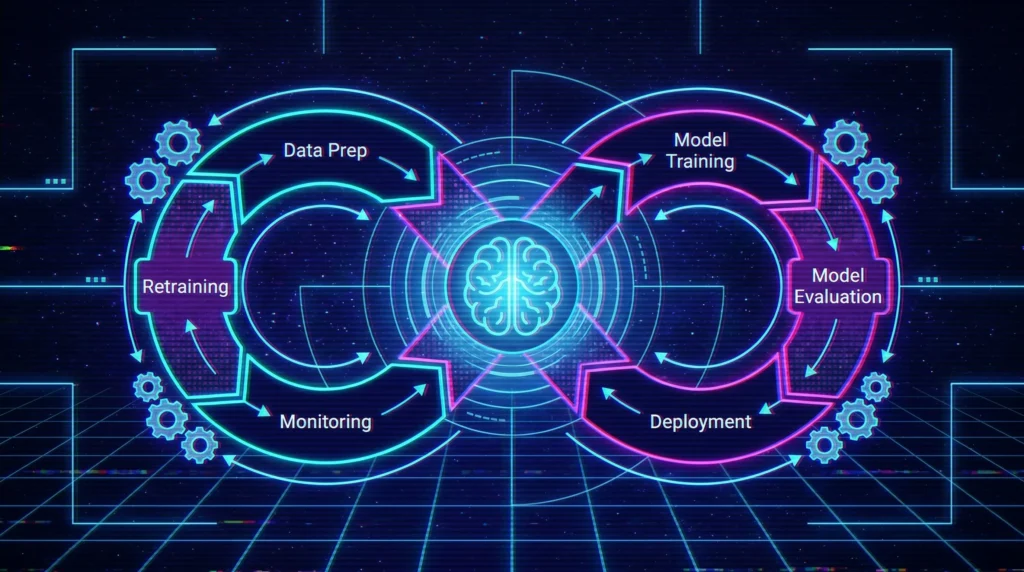
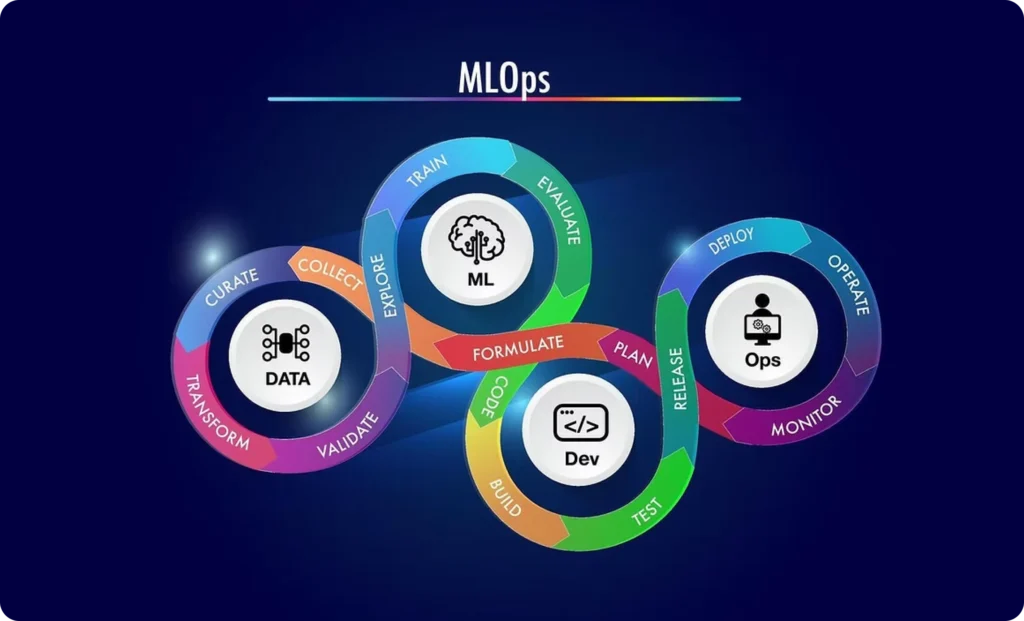
End-to-end ML pipeline design and implementation – data ingestion, feature engineering, model training, evaluation, and deployment – orchestrated through Apache Airflow, Kubeflow, and Dagster with version control, dependency management, and automated failure recovery at every stage. Models move from code commit to production without manual operational handoffs.

CI/CD for Machine Learning

Continuous integration and deployment pipelines for ML models – automated testing of model performance, data schema validation, feature distribution checks, and integration testing before any model version is promoted to production. Every release gated against defined accuracy, latency, and business KPI thresholds with one-click rollback capability.

Model Registry & Version Management

Centralised model registry with full versioning, lineage tracking, experiment logging, metadata management, and deployment history – built on MLflow, Vertex AI Model Registry, or Azure ML. Every production model traceable from training data through feature pipeline to inference output, with complete audit documentation for compliance review.

Real-Time Performance Monitoring & Alerting

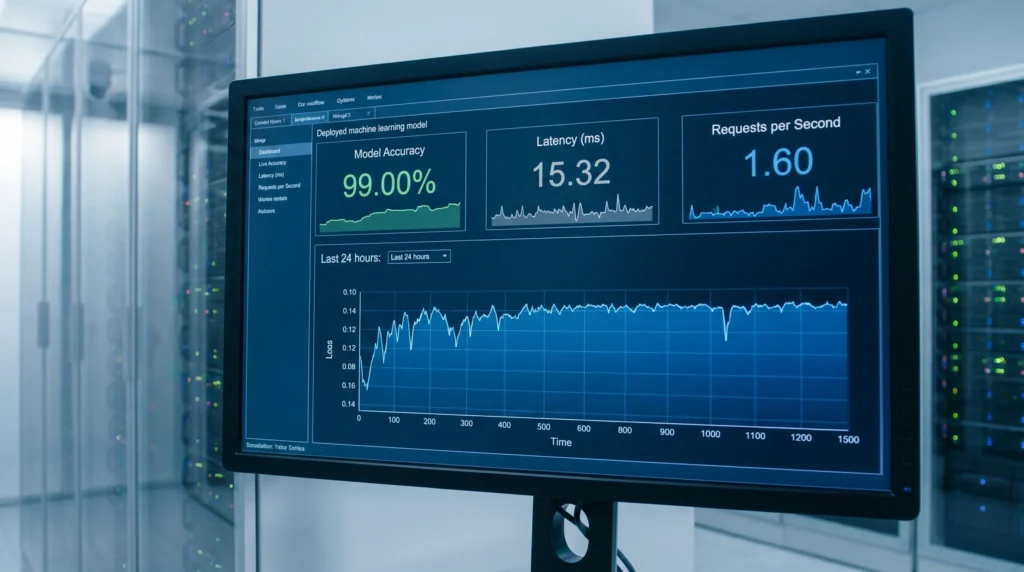
Production model monitoring dashboards tracking prediction accuracy, data drift, feature drift, prediction drift, and inference latency — with automated alerting before degradation impacts business outcomes. Monitoring implemented using Evidently AI, Arize AI, WhyLabs, and custom observability frameworks integrated with your existing alerting infrastructure.

Automated Model Retraining Pipelines

Drift-triggered and schedule-based retraining pipelines that automatically retrain models on updated data, evaluate performance against holdout validation sets, run quality gates, and redeploy — without manual data science team intervention at every cycle. Retraining pipelines built on Airflow, Dagster, and Prefect with configurable trigger conditions and rollback safeguards.

Feature Store Design & Management

Enterprise feature store implementation — centralised feature computation, storage, versioning, and serving for both training and real-time inference. Eliminating training-serving skew, reducing feature engineering duplication across teams, and enabling consistent feature computation at model training and production scoring time.

Data Validation & Quality Pipelines

Systematic data validation at every pipeline stage — schema enforcement, completeness checks, distribution monitoring, and training-serving skew detection — implemented using Great Expectations and custom validation frameworks. Every model training run validated against defined data quality thresholds before proceeding.

LLMOps for Generative AI

Operational infrastructure for production GenAI systems – prompt versioning, LLM performance monitoring, hallucination rate tracking, token cost optimisation, RAG pipeline accuracy monitoring, and automated evaluation using RAGAS and DeepEval. GenAI applications managed with the same operational rigour applied to traditional ML production systems.

MLOps Platform Assessment & Maturity Uplift

Structured assessment of your current MLOps maturity – pipeline automation, monitoring coverage, governance gaps, and tooling alignment – producing a prioritised roadmap from your current state to target MLOps capability, with phased implementation milestones and infrastructure investment guidance.

ML Governance & Compliance Documentation

Model cards, data sheets, training data documentation, evaluation reports, and regulatory submission evidence – produced and maintained throughout the ML lifecycle. Every production model audit-ready for SEC, FCA, FDA SaMD, and ISO regulatory review without emergency documentation effort during compliance events.

Our MLOps Technology Stack

Production-proven platforms selected based on your cloud environment, existing data infrastructure, and compliance requirements – not our defaults.

  • All
  • Languages
  • Gen AI platforms
  • Frameworks
  • Debugging & Tracing
  • Vector Databases
  • DBMS
  • Data Visualization

Languages

C#

C#

Rust

Rust

Python

Python

JavaScript

JavaScript

Java

Java

R

R

Gen AI platforms

LangChain

LangChain

Hugging Face

Hugging Face

Apache Spark

Apache Spark

Gemini

Gemini

Phi

Phi

Frameworks

LangChain

LangChain

LlamaIndex

LlamaIndex

PyTorch

PyTorch

Kedro

Kedro

TensorFlow

TensorFlow

Keras

Keras

Debugging & Tracing

Langsmith

Langsmith

Langfuse

Langfuse

Vector Databases

PostgreSQL

PostgreSQL

Chroma

Chroma

Milvus

Milvus

Qdrant

Qdrant

Pinecone

Pinecone

DBMS

PostgreSQL

PostgreSQL

MySQL

MySQL

MongoDB

MongoDB

CouchDB

CouchDB

Cassandra

Cassandra

Neo4j

Neo4j

Data Visualization

Power BI

Power BI

Tableau

Tableau

Languages

C#

C#

Rust

Rust

Python

Python

JavaScript

JavaScript

Java

Java

R

R

Gen AI platforms

LangChain

LangChain

Hugging Face

Hugging Face

Apache Spark

Apache Spark

Gemini

Gemini

Phi

Phi

Frameworks

LangChain

LangChain

LlamaIndex

LlamaIndex

PyTorch

PyTorch

Kedro

Kedro

TensorFlow

TensorFlow

Keras

Keras

Debugging & Tracing

Langsmith

Langsmith

Langfuse

Langfuse

Vector Databases

PostgreSQL

PostgreSQL

Chroma

Chroma

Milvus

Milvus

Qdrant

Qdrant

Pinecone

Pinecone

DBMS

PostgreSQL

PostgreSQL

MySQL

MySQL

MongoDB

MongoDB

CouchDB

CouchDB

Cassandra

Cassandra

Neo4j

Neo4j

Data Visualization

Power BI

Power BI

Tableau

Tableau

Ready to Make Your AI Deliver at Scale?

Image
Image

MLOps By Industry

MLOps Solutions We Can Design, Build & Operate

Proven MLOps infrastructure patterns – purpose-engineered for the scale, compliance requirements, and technology landscapes of enterprise AI programmes.

regenerate_2K_202606151610 - Copy
Enterprise ML Platform Build

End-to-end MLOps platform design and implementation - pipeline orchestration, feature store, model registry, CI/CD, monitoring, and governance - built on your cloud environment (AWS, Azure, or GCP) and integrated with your existing data platform, security policies, and operational tooling.
MLOps Modernisation Programme

Assessment and modernisation of existing ad-hoc or fragmented ML operations - migrating notebook-based workflows to automated pipelines, implementing model registry and versioning, deploying monitoring infrastructure, and establishing CI/CD practices across your current model portfolio.
Workplace SafProduction Model Monitoring & Alerting Systemety Monitoring

Comprehensive monitoring implementation across your production model fleet - data drift, feature drift, prediction drift, and business KPI tracking - with automated alerting, escalation workflows, and integration into your existing operational dashboards and incident management systems.

Automated Retraining Infrastructure

Design and implementation of automated retraining pipelines for your production models — drift-triggered and schedule-based retraining, automated evaluation against holdout data, quality gate enforcement, and controlled redeployment with rollback capability across your entire production model portfolio.

Feature Store Implementation

Enterprise feature store design and deployment - centralised feature computation, versioning, and serving for training and real-time inference - eliminating training-serving skew, reducing feature engineering duplication, and enabling consistent feature governance across your data science organisation.

LLMOps Infrastructure for GenAI

Operational infrastructure for your production GenAI applications - prompt versioning, LLM evaluation pipelines, RAG accuracy monitoring, hallucination detection, token cost tracking, and automated quality assurance - managed with the same rigour as your traditional ML production systems.

MLOps for Regulated Industries

Compliance-aligned MLOps implementation for financial services, healthcare, manufacturing, and energy - model cards, data documentation, evaluation reports, bias monitoring, explainability integration, and audit-ready governance documentation meeting SEC, FCA, FDA SaMD, and ISO regulatory requirements.

ML Platform Migration

Migration of existing ML infrastructure between cloud platforms or from on-premises to cloud - including pipeline migration, model artefact migration, monitoring infrastructure rebuild, and team capability transfer - with minimal disruption to production model operations during transition.


Our Process For MLOps Implementation

A structured five-stage process – from MLOps maturity assessment to governed production platform – with defined outputs and validation at every stage.

MLOps Maturity Assessment

Current state audit of pipeline automation, model versioning, monitoring coverage, governance practices, and tooling alignment – gap analysis and prioritised MLOps roadmap produced before any infrastructure work begins.

Platform Architecture & Tooling Design

MLOps platform design – pipeline orchestration framework, feature store architecture, model registry, CI/CD toolchain, monitoring stack, and governance framework – aligned to your cloud environment, data platform, security policies, and compliance requirements.

Pipeline & Infrastructure Build

ML pipeline implementation, feature store deployment, model registry configuration, CI/CD pipeline development, data validation framework implementation, and monitoring infrastructure deployment — built and validated against your production data sources and model portfolio.

Migration, Integration & Team Enablement

Migration of existing models and workflows to the new MLOps platform, integration with operational systems and alerting infrastructure, and data science team enablement – ensuring your teams can operate, extend, and govern the platform independently after handover.

Ongoing Operations & Continuous Improvement

MLOps platform operations support, monitoring coverage expansion, governance documentation maintenance, platform capability uplift, and regular MLOps maturity reviews – sustained operational reliability as your AI portfolio scales and your compliance requirements evolve.

Why Enterprises Choose Us For MLOps

Building production MLOps demands ML engineering depth, cloud platform expertise, and regulated-industry compliance experience – not DevOps principles applied to ML without domain knowledge.

  • Engineering-led MLOps delivery built on real-world experience operating production ML systems for Fortune 500 enterprises.
  • Cloud-agnostic MLOps expertise across AWS SageMaker, Azure Machine Learning, and Google Vertex AI aligned to existing infrastructure and compliance requirements.
  • End-to-end MLOps pipelines covering model training, deployment, monitoring, retraining, governance, and CI/CD automation.

  • Dedicated LLMOps capability for GenAI systems, including RAG pipelines, foundation model operations, and agentic AI governance.
  • Vendor-independent tooling selection across Airflow, Dagster, Prefect, MLflow, Weights & Biases, Evidently, Arize, and related ecosystems.
  • Full lifecycle accountability spanning MLOps assessment, platform engineering, model migration, team enablement, and ongoing operational support.
Ai ML service
Don't Worry!

Our expert will solve your queries in one call.

Client Triumphs: Success Stories

Discover how our team of domain specialists have addressed industry-specific challenges and mission-critical needs. Turning your Vision into Victory, One Success Story at a time!

MLOps & AI Operations FAQs

Have a question? We’re here to help.

What is MLOps and why does enterprise AI require it?

MLOps (Machine Learning Operations) is the discipline of operationalising AI models at enterprise scale — combining ML engineering with DevOps practices to automate pipeline management, ensure model reliability, maintain compliance, and sustain model performance in production. Without MLOps, models degrade silently as data distributions change, deployments become manual bottlenecks requiring expert intervention, compliance documentation is produced reactively, and your data science team spends more time on operational maintenance than model improvement.


What MLOps services does Kernshell provide?

End-to-end MLOps ML pipeline automation, CI/CD for models, model registry and versioning, feature store design and implementation, real-time performance monitoring, drift detection, automated retraining, data validation, ML governance documentation, and LLMOps for GenAI applications – deployed across AWS SageMaker, Azure ML, and Google Vertex AI.

What is the difference between MLOps and DevOps?

DevOps automates software application delivery – code testing, build, deployment, and infrastructure management. MLOps extends these principles for machine learning – adding model versioning, training pipeline automation, feature engineering management, training-serving skew detection, model performance monitoring, drift alerting, and automated retraining workflows that have no direct equivalent in traditional software delivery. The core challenge MLOps addresses that DevOps does not: software doesn’t degrade because the world changes; models do.

What is LLMOps and how does it differ from traditional MLOps?

LLMOps covers the operational challenges specific to large language models and GenAI applications – prompt versioning, LLM evaluation frameworks, RAG pipeline accuracy monitoring, hallucination detection and rate tracking, token cost optimisation, and foundation model version management. Traditional MLOps addresses structured ML models with defined input features and output labels; LLMOps addresses the distinct operational requirements of foundation models where outputs are generative, quality is multi-dimensional, and cost is token-consumption-based rather than inference-compute-based.

How does Kernshell approach model drift detection and automated retraining?

We implement drift monitoring across three dimensions – data drift (input distribution shifts), concept drift (changes in the relationship between inputs and outputs), and prediction drift (changes in model output distributions). When drift exceeds configurable thresholds, automated retraining pipelines trigger model retraining on updated data, evaluate performance against holdout validation sets using defined quality gates, and execute controlled redeployment with automatic rollback if quality thresholds are not met  -without requiring manual data science intervention at each retraining cycle.

How does Kernshell handle MLOps compliance requirements in regulated industries?

Compliance is designed into the MLOps platform architecture from the first design decision – not added as a documentation layer after the infrastructure is built. For regulated clients, we implement model cards and data sheets updated at every model version, training data documentation with lineage to source systems, evaluation reports against defined performance standards, bias monitoring integrated into the retraining pipeline, SHAP-based explainability generation for audit requests, and role-based access controls governing who can promote, modify, or retire production models. All documentation is structured for SEC, FCA, FDA SaMD, and ISO regulatory submission without emergency preparation effort.

How long does an MLOps implementation take?

A focused MLOps implementation – automated pipeline for an existing model portfolio, monitoring infrastructure deployment, and CI/CD setup – typically completes in 8–12 weeks. A full enterprise MLOps platform build including feature store, model registry, monitoring stack, CI/CD, governance framework, and team enablement is typically scoped at 16–24 weeks depending on the size of your model portfolio, cloud environment complexity, and compliance documentation requirements. Both are structured with clear milestones following the MLOps maturity assessment.

Still Have Questions?

Can’t find the answer you’re looking for? Please get in touch with our team.

We Empower 170+ Global Businesses

Mars Logo
Johnson Logo
Kimberly Clark Logo
Coca Cola Logo
loreal logo
Jabil Logo
Hitachi Energy Logo
SkyWest Logo

Let’s innovate together!

Engage with a premier team renowned for transformative solutions and trusted by multiple Fortune 100 companies. Our domain knowledge and strategic partnerships have propelled global businesses.
Let’s collaborate, innovate and make technology work for you!

Our Locations

101 E Park Blvd, Plano,
TX 75074, USA

1304 Westport, Sindhu Bhavan Marg,
Thaltej, Ahmedabad, Gujarat 380059, INDIA

Phone Number

+1 817 380 5522


    Loading...

    Area Of Interest *

    Explore Our Service Offerings

    Hire A Team / Developer

    Become A Technology Partner

    Job Seeker

    Other