



















How to Hire Remote Developers in USA – Complete Guide 2026

The demand for remote software developers in the USA has never been higher. Whether you’re a startup scaling fast or an enterprise modernizing its tech stack, hiring remote developers gives you access to a wider talent pool, reduced overhead, and faster time-to-hire. But doing it right requires a clear strategy.
This guide walks you through everything you need to know about hiring remote developers in the USA in 2026 from defining your needs to onboarding your first hire.
Why Hire Remote Developers in 2026?
The remote work model has matured significantly. According to recent industry data, over 60% of software developers in the USA now work remotely either full-time or in a hybrid arrangement. For businesses, this shift unlocks several advantages:
-
- Access to nationwide talent without geographic restrictions
- Lower operational costs compared to in-office setups
- Faster hiring cycles through digital-first recruitment
- Higher developer satisfaction, which translates to better retention
Remote hiring is no longer a workaround; it’s a competitive advantage.
Step 1: Define Your Technical Requirements
Before you post a job listing, you need clarity on what you’re building and what skills it requires. Ask yourself:
-
- What programming languages, frameworks, or platforms are needed? (e.g., React, Node.js, Python, AWS)
- Is this a short-term project or a long-term engagement?
- Do you need a full-stack developer, a specialist, or a team?
- What level of experience is required — junior, mid-level, or senior?
A well-defined job description reduces time-to-hire and attracts better-fit candidates.
Step 2: Choose the Right Hiring Model
There are three primary models for hiring remote developers in the USA:
-
- Full-Time Remote Employees
Best for long-term product development. You hire the developer as a W-2 employee or a 1099 contractor, providing stability and deeper team integration. - Freelance / Contract Developers
Ideal for short-term projects or specialized tasks. Platforms like Toptal, Upwork, and Gun.io connect you with vetted freelancers quickly. - Dedicated Development Teams
For larger builds, you can partner with a remote development agency that provides a dedicated team, including developers, QA, and project managers.
- Full-Time Remote Employees
Step 3: Where to Find Remote Developers in the USA
Here are the top platforms and channels to source talent:
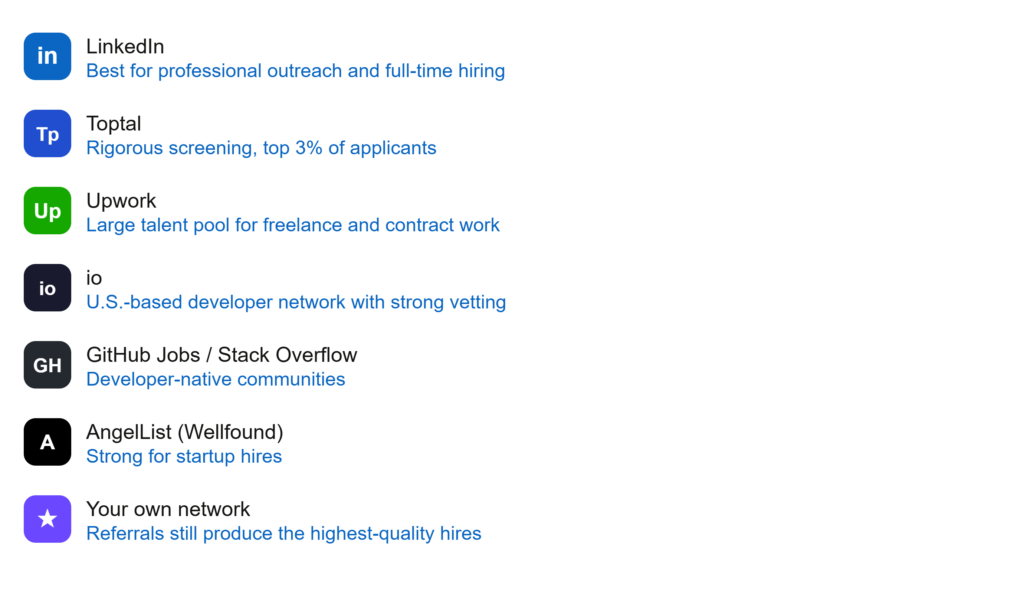 Don’t rely on a single channel. A multi-platform approach yields better results faster.
Step 4: Screening and Technical Vetting
Resumes don’t build software skills do. Use a structured screening process:
-
- Resume + Portfolio Review – Look for relevant projects, open-source contributions, and GitHub activity.
- Technical Assessment – Use tools like HackerRank, Codility, or a take-home project to evaluate real-world problem-solving.
- Live Coding Interview – Assess thinking process, not just syntax knowledge.
- Behavioral Interview – Remote work demands strong communication, time management, and self-direction. Ask situational questions.
- Reference Checks – Always verify past work and professional conduct.
Step 5: Legal and Compliance Considerations
Hiring remote developers in the USA involves important legal obligations:
-
- W-2 vs. 1099 classification – Misclassifying an employee as an independent contractor can lead to IRS penalties. Know the difference.
- State-specific employment laws – Each U.S. state has its own rules around minimum wage, benefits, and termination.
- IP and NDAs – Always have developers sign a confidentiality agreement and assign intellectual property rights before work begins.
- Data security compliance – If your product handles sensitive data, ensure your remote developers comply with HIPAA, SOC 2, or relevant standards.
Consult an employment attorney or use a platform like Deel or Remote.com to manage compliance at scale.
Step 6: Remote Developer Salary Benchmarks (2026)
|
Role |
Average Annual Salary (USA) |
| Junior Developer | $70,000 – $95,000 |
| Mid-Level Developer | $100,000 – $140,000 |
| Senior Developer | $145,000 – $200,000+ |
| Full-Stack Developer | $110,000 – $165,000 |
| DevOps / Cloud Engineer | $130,000 – $185,000 |
Understanding market rates helps you budget accurately and make competitive offers:
Rates vary by tech stack, location (even remotely), and industry.
Step 7: Onboarding and Remote Team Management
A strong onboarding process sets the tone for the entire working relationship:
-
- Provide clear documentation on codebase, tools, and workflows
- Set up access to communication tools (Slack, Zoom, Notion)
- Assign a mentor or buddy for the first 30 days
- Define KPIs and check-in cadence from day one
Tools like Jira, GitHub, Linear, and Confluence are standard in remote development environments.
Common Mistakes to Avoid
-
- Hiring based on cost alone rather than fit and quality
- Skipping legal documentation
- Failing to establish communication expectations upfront
- Neglecting time zone overlaps for real-time collaboration

Final Thoughts
Hiring remote developers in the USA in 2026 is both an art and a science. The companies that do it well move faster, build better, and attract stronger talent. Start with clear requirements, vet rigorously, stay compliant, and invest in onboarding – and you’ll build a remote development team that delivers real results.